Return an array of all overlaps between two arrays of intervals; intervals1 and intervals2. Each individual interval array is sorted by start value, and contains no overlapping intervals within itself.
For every index i in intervals1, intervals1[i].start < intervals1[i].end.
For every index j in intervals2, intervals2[j].start < intervals2[j].end.
In Plain English
New to this one? Start here. Below is the core idea in everyday language, plus a real-world analogy—then the sections that follow build on it with the formal reasoning, code, and step-by-step walkthroughs.
📅 A real-world picture: two people’s busy calendars
You have your busy blocks for the day and your teammate has theirs. To find every window when you are both busy at the same time, you slide down both calendars together. Since each calendar is already in time order, you never backtrack — you just keep comparing the two blocks at the front and step past whichever one finishes first.
Intuition
We’re given two arrays of intervals, each containing non-overlapping intervals. This implies an overlap can only occur between an interval from the first array and an interval from the second array.
Let’s start by learning how to identify an overlap between two overlapping intervals.
Identifying the overlap between two overlapping intervals
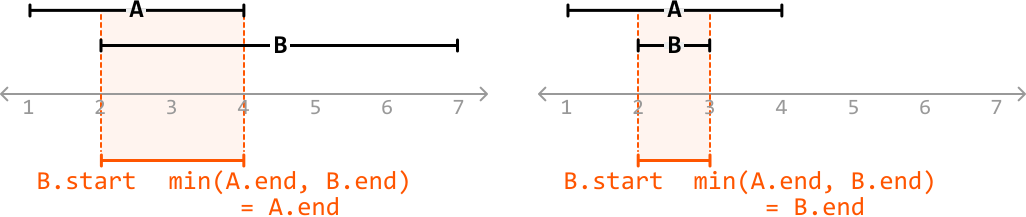
We know from the Merge Overlapping Intervals problem that two intervals, A and B, overlap when A.end ≥ B.start, assuming we know A starts before B. Let’s have a look at a couple of examples which each contain two overlapping intervals that match this condition:
To extract the overlap between these two overlapping intervals, we’ll need to identify when it starts and ends.
The overlap starts at the furthest start point, which is always B.start.
The overlap ends at the earliest end point (min(A.end, B.end)).
Therefore, when two intervals overlap, their overlap is defined by the range [B.start, min(A.end, B.end)]. Remember that in all these cases, interval A always starts first.
Identifying all overlaps
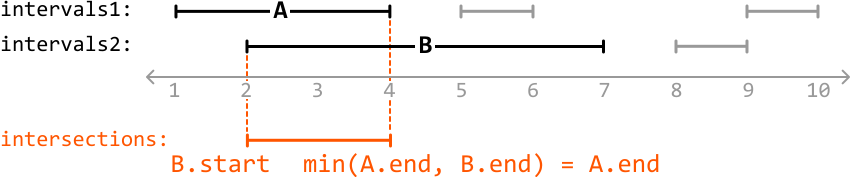
Now, let’s return to the two arrays of intervals. Consider this example:
Let’s start by considering the first interval from each array:
To check if these intervals overlap, we’ll need to identify which interval between intervals1[i] and intervals2[j] starts first, so we can assign that interval as interval A and the other as interval B. The code snippet for this is provided below:
# Set A to the interval that starts first and B to the other interval.if intervals1[i].start <= intervals2[j].start:
A, B = intervals1[i], intervals2[j]
else:
A, B = intervals2[j], intervals1[i]
In this example, intervals1[i] starts first:
A and B overlap when A.end ≥ B.start, which is true here. Since they overlap, let’s record their overlap: [B.start, min(A.end, B.end)]:
Now that we’ve identified the overlap between those two intervals, let’s move on to the next pair by advancing the pointer at one of the interval arrays. Since intervals1[i] ends before intervals2[j], we know that intervals1[i] won’t overlap with any more intervals from the intervals2 array, so let’s increment the intervals1 pointer (i) to move to the next interval in this array:
Note, we use intervals1[i] and intervals2[j] instead of A and B since we don’t know which interval array A or B belongs to.
We’ve now identified a process that allows us to identify and record all overlaps while traversing the arrays of intervals. For the pair of intervals being considered at i and j:
Set A as the interval that starts first, and B as the other interval.
Check if A.end ≥ B.start to see if these intervals overlap. If they do, record the overlap as [B.start, min(A.end, B.end)].
Whichever interval ends first, advance its corresponding pointer to move to the next interval.
Continue to apply these steps until either i or j have passed the end of their array. Once this happens, we know there won’t be any more overlapping intervals.
Implementation
from typing import List
from ds import Interval
def identify_all_interval_overlaps(intervals1: List[Interval], intervals2: List[Interval]) -> List[Interval]:
overlaps = []
i = j = 0
while i < len(intervals1) and j < len(intervals2):
# Set A to the interval that starts first and B to the other interval.
if intervals1[i].start <= intervals2[j].start:
    A, B = intervals1[i], intervals2[j]
else:
    A, B = intervals2[j], intervals1[i]
# If there's an overlap, add the overlap.
if A.end >= B.start:
overlaps.append(Interval(B.start, min(A.end, B.end)))
# Advance the pointer associated with the interval that ends first.
if intervals1[i].end < intervals2[j].end:
i += 1
else:
j += 1
return overlaps
vector<Interval> identifyAllIntervalOverlaps(vector<Interval>& a, vector<Interval>& b) {
    vector<Interval> overlaps;
    int i = 0, j = 0;
    while (i < (int)a.size() && j < (int)b.size()) {
        Interval A, B;
        if (a[i].start <= b[j].start) {   // A is whichever interval starts first
            A = a[i];
            B = b[j];
        } else {
            A = b[j];
            B = a[i];
        }
        if (A.end >= B.start) {           // they overlap
            overlaps.push_back(Interval(B.start, min(A.end, B.end)));
        }
        if (a[i].end < b[j].end) {        // advance whichever ends first
            i++;
        } else {
            j++;
        }
    }
    return overlaps;
}
List<Interval> identifyAllIntervalOverlaps(List<Interval> a, List<Interval> b) {
    List<Interval> overlaps = new ArrayList<>();
    int i = 0, j = 0;
    while (i < a.size() && j < b.size()) {
        Interval A, B;
        if (a.get(i).start <= b.get(j).start) { A = a.get(i); B = b.get(j); }
        else { A = b.get(j); B = a.get(i); }
        if (A.end >= B.start) overlaps.add(new Interval(B.start, Math.min(A.end, B.end)));
        if (a.get(i).end < b.get(j).end) i++; else j++;
    }
    return overlaps;
}
Complexity Analysis
Time complexity: The time complexity of identify_all_interval_overlaps is O(n+m) where n and m are the lengths of intervals1 and intervals2, respectively. This is because we traverse each interval in both arrays exactly once.
Space complexity: The space complexity is O(1). Note that the overlaps array is not considered because space complexity is only concerned with extra space used and not space taken up by the output.
Dry Runs
Two step-by-step walkthroughs of the algorithm below: a valid case (the expected happy path) and an invalid / edge case that exercises the tricky parts. Each step shows the program state as the code runs—the same steps apply to Python, C++ and Java.
✅ Dry run 1 (rich — three overlaps) — list1 = [[1,5],[7,9]], list2 = [[2,3],[4,8]]
Stack the two calendars on one number line; an overlap is anywhere the top and bottom bars sit over the same column.
Teal = list1, neutral = list2. Where they cross, green marks the overlaps: [2,3], [4,5], [7,8].
A (starts first) overlap recorded pointer advanced
i=0, j=0: [1,5] vs [2,3]. A=[1,5] starts first; 5 ≥ 2 → overlap [2, min(5,3)=3]. Ends: 5 vs 3 → advance j.
[1,5]
[2,3]
→ [2,3]
i=0, j=1: [1,5] vs [4,8]. A=[1,5] starts first; 5 ≥ 4 → overlap [4, min(5,8)=5]. Ends: 5 vs 8 → advance i.
Overlap = [B.start, min(A.end, B.end)] when A.end ≥ B.start; then step the smaller end.
i, j
list1[i]
list2[j]
A (starts first)
overlap
advance
0, 0
[1,5]
[2,3]
[1,5]
[2,3]
j (3<5)
0, 1
[1,5]
[4,8]
[1,5]
[4,5]
i (5<8)
1, 1
[7,9]
[4,8]
[4,8]
[7,8]
j (8<9)
❗ Dry run 2 (no overlaps — calendars interlock) — list1 = [[0,1],[4,5],[8,9]], list2 = [[2,3],[6,7]]
Each of list2’s blocks falls neatly into a gap of list1. The pointers still traverse everything, but no two bars ever share a column.
Each of list2’s blocks falls into a gap of list1 — nothing lines up, so overlaps = [].
A (starts first) no overlap pointer advanced
i=0, j=0: [0,1] vs [2,3]. A=[0,1]; 1 ≥ 2? no → miss. Ends: 1 vs 3 → advance i.
[0,1]
[2,3]
i=1, j=0: [4,5] vs [2,3]. A=[2,3]; 3 ≥ 4? no → miss. Ends: 5 vs 3 → advance j.
[4,5]
[2,3]
i=1, j=1: [4,5] vs [6,7]. A=[4,5]; 5 ≥ 6? no → miss. Ends: 5 vs 7 → advance i.
[4,5]
[6,7]
i=2, j=1: [8,9] vs [6,7]. A=[6,7]; 7 ≥ 8? no → miss. Ends: 9 vs 7 → advance j (list2 done).
[8,9]
[6,7]
final output: [] — no shared time at all ✓
The same run as a table
When A.end ≥ B.start is false every step, the pointers sweep both lists and record nothing.
i, j
list1[i]
list2[j]
A (starts first)
A.end ≥ B.start?
advance
0, 0
[0,1]
[2,3]
[0,1]
1≥2 no
i (1<3)
1, 0
[4,5]
[2,3]
[2,3]
3≥4 no
j (3<5)
1, 1
[4,5]
[6,7]
[4,5]
5≥6 no
i (5<7)
2, 1
[8,9]
[6,7]
[6,7]
7≥8 no
j (7<9)
Take-away: the pointer logic is the same whether or not overlaps exist. It always advances the smaller end, so it visits each interval exactly once — O(m + n) no matter what.
The same steps in each language
The tuple swap A, B = intervals1[i], intervals2[j] (or the reverse) picks the earlier-starting interval as A in one line. The rest is index access intervals1[i] / intervals2[j].
We declare Interval A, B; (the default constructor makes that legal) and assign inside the branch. Access is a[i] / b[j]; everything else matches Python.
Access is a.get(i) / b.get(j), and overlaps are built with new Interval(...). The branch that chooses A and the advance rule are identical to the other two.