Given an array of intervals, determine the maximum number of intervals that overlap at any point. Each interval is half-open, meaning it includes the start point but excludes the end point.
For every index i in the list, intervals[i].start < intervals[i].end.
In Plain English
New to this one? Start here. Below is the core idea in everyday language, plus a real-world analogy—then the sections that follow build on it with the formal reasoning, code, and step-by-step walkthroughs.
🏢 A real-world picture: how many meeting rooms do I need?
Every meeting is an interval. If three meetings are happening at 10:15 at the same time, you need at least three rooms right then. The busiest instant — the most meetings running at once — is exactly the number of rooms you must book. Same math counts peak visitors in a building, peak concurrent downloads, or peak cars on a stretch of road.
Intuition
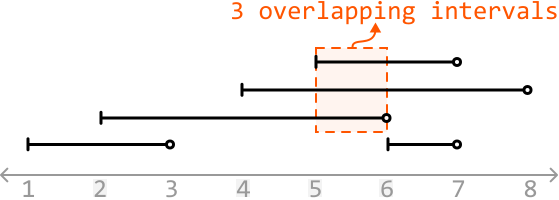
Think about what it means when x intervals overlap at a certain point in time. This means at this point, there are x “active” intervals, where an interval is active if it has started but not ended.
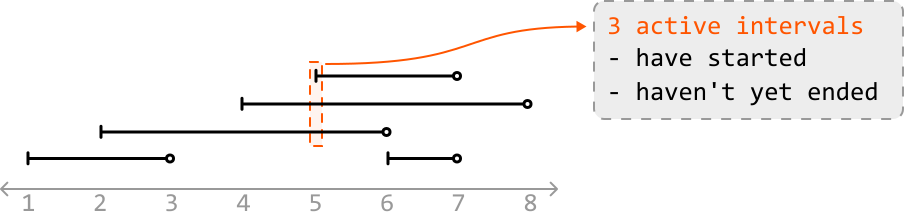
In the example below, we see three active intervals at time 5 (intervals that started at or before this time, and haven’t yet ended):
To find the number of active intervals at any point in time, we need to identify when an interval has started and when an interval has ended. The start point of an interval indicates the start of a new active interval, whereas an end point represents an active interval finishing. This suggests an approach which looks at start and end points individually could be useful. Let’s explore this idea further.
Processing start points and end points
Let’s step through each point in the array of intervals in chronological order, and see if we can determine the number of active intervals at each point.
The first point is a start point, indicating the start of the first active interval. So, let’s increment our counter:
The next point is another start point. This is the start of the second active interval, so let’s increment our counter again. Now, the number of active intervals is 2, which correctly corresponds with the number of overlapping intervals at this point:
The next point is an end point, which means an active interval has just finished. So, let’s decrement our counter. Now, the number of active intervals is 1, which also corresponds with the current number of overlapping intervals:
We’ve now rationalized what we need to do whenever we encounter a start point or end point:
If we encounter a start point: increment active_intervals.
If we encounter an end point: decrement active_intervals.
Processing the remaining points allows us to attain the number of active intervals at each point. The final answer is obtained by recording the largest value of active_intervals.
Edge case: processing concurrent start and end points
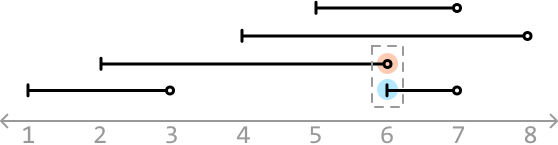
An edge case to consider is when a start and end point occur simultaneously:
Which point should we process first? Keep in mind the value of active_intervals is 3 right before we reach time = 6 in the above example.
At time 6, if we process the start point first and increment active_intervals, we would update it to 4 first, which is incorrect as there are never 4 active intervals at this moment. This is an issue because our final answer is the largest value of active_intervals encountered, which means we’ll incorrectly record 4 as the answer.
If we process the end point first, we won’t encounter this issue:
Therefore, for start and end points that occur simultaneously, we should process end points before start points.
Iterating over interval points in order
We need a way to iterate through the start and end points in the order they should be processed. To do this, we can combine all start and end points into a single array and sort it. For start and end points of the same value, we ensure end points are prioritized before start points while the points are being sorted.
Let’s use ‘S’ and ‘E’ to differentiate between start and end points, respectively:
The algorithm we used to solve this problem is known as a ‘sweeping line algorithm.’ It works by processing the start and end points of intervals in order, as if a vertical line was sweeping across them. This method efficiently handles the dynamic nature of interval overlaps by specifically focusing on start and end points, rather than individual intervals.
Implementation
from typing import List
from ds import Interval

def largest_overlap_of_intervals(intervals: List[Interval]) -> int:
   points = []
   for interval in intervals:
       points.append((interval.start, 'S'))
       points.append((interval.end, 'E'))
   # Sort in chronological order. If multiple points occur at the same time, ensure
   # end points are prioritized before start points in the sorting order.
   points.sort(key=lambda x: (x[0], x[1]))
   active_intervals = 0
   max_overlaps = 0
   for time, point_type in points:
       if point_type == 'S':
           active_intervals += 1
       else:
           active_intervals -= 1
       max_overlaps = max(max_overlaps, active_intervals)
   return max_overlaps
int largestOverlapOfIntervals(vector<Interval>& intervals) {
    vector<pair<int,int>> points;                  // (time, type) 0 = End, 1 = Start
    for (auto& iv : intervals) {
        points.push_back({iv.start, 1});
        points.push_back({iv.end, 0});
    }
    sort(points.begin(), points.end());            // ties: End(0) before Start(1)
    int active = 0, best = 0;
    for (auto& p : points) {
        if (p.second == 1) {    // a Start adds one active interval
            active++;
        } else {                // an End removes one
            active--;
        }
        best = max(best, active);
    }
    return best;
}
int largestOverlapOfIntervals(List<Interval> intervals) {
    List<int[]> points = new ArrayList<>();       // {time, type} 0 = End, 1 = Start
    for (Interval iv : intervals) {
        points.add(new int[]{iv.start, 1});
        points.add(new int[]{iv.end, 0});
    }
    points.sort((p, q) -> p[0] != q[0] ? p[0] - q[0] : p[1] - q[1]);
    int active = 0, best = 0;
    for (int[] p : points) {
        if (p[1] == 1) active++; else active--;
        best = Math.max(best, active);
    }
    return best;
}
Complexity Analysis
Time complexity: The time complexity of largest_overlap_of_intervals is O(nlog(n)), where n denotes the number of intervals. This is because we sort the points array of size 2n before iterating over it in O(n) time.
Space complexity: The space complexity is O(n) due to the space taken up by the points array.
Dry Runs
Two step-by-step walkthroughs of the algorithm below: a valid case (the expected happy path) and an invalid / edge case that exercises the tricky parts. Each step shows the program state as the code runs—the same steps apply to Python, C++ and Java.
✅ Dry run 1 (rich — a real peak of 3) — intervals = [[1,3],[5,7],[2,6],[4,8]]
On the timeline, the answer is simply the tallest “stack” of bars. The count strip shows how many are active during each unit.
At time = 5 three intervals are active at once (green) — that is the peak overlap of 3.
count hits a new best start (+1) end (−1)
Sorted events (End before Start at equal times): 1S, 2S, 3E, 4S, 5S, 6E, 7E, 8E.
1S
2S
3E
4S
5S
6E
7E
8E
Sweep: +1,+1 → 2; −1 → 1; +1 → 2; +1 → 3 (new best); then −1,−1,−1 down to 0.answer = 3 ✓
The same run as a table
Add on a start, subtract on an end; best tracks the running maximum.
event
+1 / −1
active after
best
1 S
+1
1
1
2 S
+1
2
2
3 E
−1
1
2
4 S
+1
2
2
5 S
+1
3
3
6 E
−1
2
3
7 E
−1
1
3
8 E
−1
0
3
❗ Dry run 2 (touching chain — the tie-break test) — intervals = [[1,2],[2,3],[3,4]]
These three meet nose-to-tail. Half-open means the one leaving at time 2 is gone before the one arriving at 2 counts — so at no instant are two active.
These meet nose-to-tail, only touching at their endpoints — at no instant are two active together, so the peak is 1.
start (+1) end (−1) end & start collide — end wins
Sorted events — at times 2 and 3 the E sorts before the S: 1S, 2E, 2S, 3E, 3S, 4E.
1S
2E
2S
3E
3S
4E
Sweep: +1 → 1; (at t=2) −1 → 0 then +1 → 1; (at t=3) −1 → 0 then +1 → 1; −1 → 0.answer = 1 ✓ — touching is not overlapping.
The same run as a table
Processing End before Start at t=2 and t=3 keeps the count from ever reaching 2.
event
+1 / −1
active after
best
1 S
+1
1
1
2 E
−1
0
1
2 S
+1
1
1
3 E
−1
0
1
3 S
+1
1
1
4 E
−1
0
1
Take-away: had we sorted Start before End, the count would have briefly hit 2 at times 2 and 3 and returned the wrong answer. The tie-break is the algorithm.
The same steps in each language
Events are tuples (time, 'S'|'E'). Sorting by (x[0], x[1]) puts 'E' before 'S' at equal times because the string 'E' < 'S' — exactly the tie-break we need.
Events are pair<int,int> with End = 0, Start = 1. The default pair comparison sorts by time then by type, so 0 (End) precedes 1 (Start) automatically.
Events are int[]{time, type} with End = 0, Start = 1, sorted by an explicit comparator p[0]!=q[0] ? p[0]-q[0] : p[1]-q[1] — same “End before Start” ordering.





![Image represents a coding pattern illustration demonstrating the transformation of a list of intervals into a sorted list of points. The top line shows a Python-like list called `intervals` containing five sub-lists, each representing an interval with a start and end point: `[1, 3]`, `[2, 6]`, `[4, 8]`, `[6, 7]`, and `[5, 7]`. A right arrow indicates a transformation to the `points` list below, which contains all the start and end points from the `intervals` list: `[1 2 3 4 5 6 6 7 7 8]`. Underneath each point in the `points` list, 'S' (in light blue) denotes a start point of an interval and 'E' (in orange) denotes an end point. A small downward-pointing arrow underlines the 'E' and 'S' representing an end point appearing before a start point, highlighting a condition where the end point of one interval is sorted before the start point of another. The text 'end point sorted before start point' explains this specific arrangement and the implication of the sorting process.](images/img-190edb090e11.svg)