Given k singly linked lists, each sorted in ascending order, combine them into one sorted linked list.
Example:
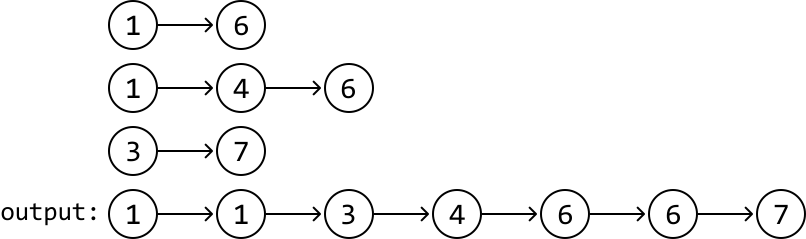
Given k singly linked lists, each sorted in ascending order, combine them into one sorted linked list.
New to this one? Start here. Below is the core idea in everyday language, plus a real-world analogy—then the sections that follow build on it with the formal reasoning, code, and step-by-step walkthroughs.
Imagine k face-up piles of cards, each pile sorted with the smallest on top. To build one sorted pile, you keep taking the smallest visible top card across all piles. The only question is “which top card is smallest right now?” — and as soon as you take one, a new card is exposed underneath. A heap answers “which top is smallest” instantly.
A good place to start with this problem is by figuring out how to merge just two sorted linked lists. We can do this by initiating a pointer at the start of both linked lists. Comparing the nodes at these pointers, add the smaller one to the output linked list and advance the corresponding pointer. This results in a combined sorted linked list:




But what if we have more than two linked lists? Combining two linked lists involves comparing two nodes at each iteration, but combining k linked lists would require k comparisons per iteration.
The reason we need to make so many comparisons is that we don't know which node has the smallest value at any point in the iteration, requiring us to search for it. Wouldn't it be nice to have an efficient way to access the smallest-valued node at any given point? A min-heap is perfect for this.
We can essentially do the same thing as in our initial approach, but instead of using pointers to determine the smallest node, we use a min-heap. Let’s see how this works over the three sorted linked lists below:
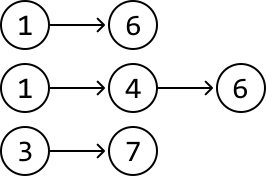
To start, populate the heap with the head nodes of all the linked lists, so they're ready for comparison:
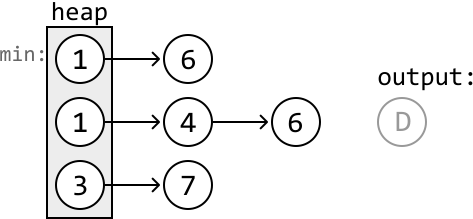
Then, let’s implement our strategy of adding the smallest-valued node to the output linked list, using the heap to identify it. We'll use a dummy node to help build the output linked list (denoted as ‘node D’ in the above diagram).
After a node is popped off, the subsequent node from its linked list is added to the heap.
Now, let’s go through the example. First, we pop off the smallest-valued node from the heap and connect it to the tail of the output list:
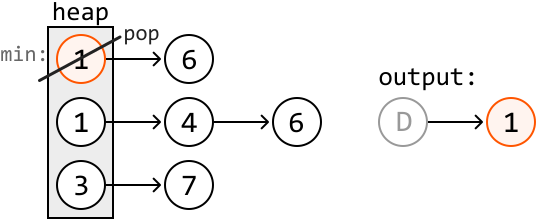
Then, add the subsequent node from the same linked list to the heap:
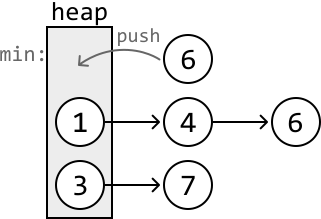
Continue this until we’ve added each node from all k linked lists to the output linked list:
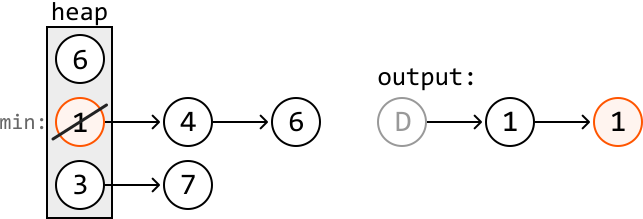
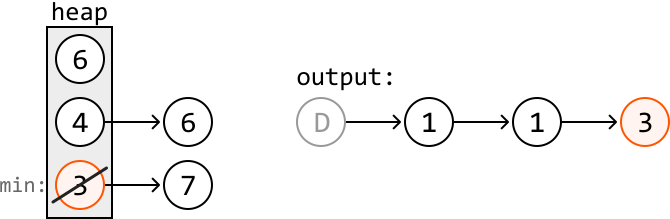
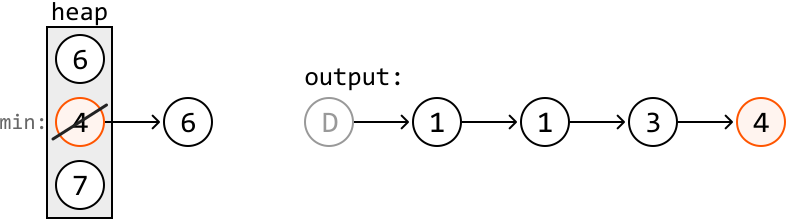
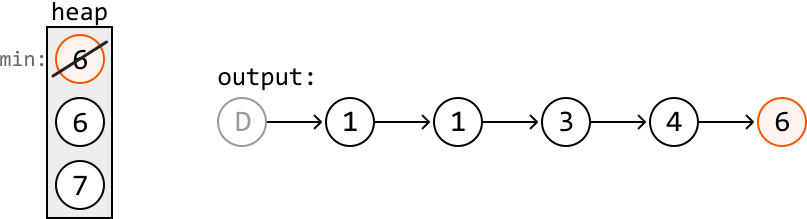


Once the heap is empty, we can return dummy.next, which is the head of the combined linked list.
Note that in the implementation below, we modify the ListNode class globally to simplify the solution. It's important to confirm with your interviewer that global variables are acceptable.
from typing import List
from ds import ListNode
import heapq

def combine_sorted_linked_lists(lists: List[ListNode]) -> ListNode:
    # Define a custom comparator for 'ListNode', enabling the min-heap to prioritize
    # nodes with smaller values.
    ListNode.__lt__ = lambda self, other: self.val < other.val
    heap = []
    # Push the head of each linked list into the heap.
    for head in lists:
        if head:
            heapq.heappush(heap, head)
    # Set a dummy node to point to the head of the output linked list.
    dummy = ListNode(-1)
    # Create a pointer to iterate through the combined linked list as we add nodes to
    # it.
    curr = dummy
    while heap:
        # Pop the node with the smallest value from the heap and add it to the output
        # linked list.
        smallest_node = heapq.heappop(heap)
        curr.next = smallest_node
        curr = curr.next
        # Push the popped node's subsequent node to the heap.
        if smallest_node.next:
            heapq.heappush(heap, smallest_node.next)
    return dummy.next
struct NodeCmp { // min-heap: smallest val on top
bool operator()(ListNode* a, ListNode* b) const {
return a->val > b->val; // min-heap by node value
}
};
ListNode* combineSortedLinkedLists(vector<ListNode*>& lists) {
priority_queue<ListNode*, vector<ListNode*>, NodeCmp> heap;
for (ListNode* head : lists) {
if (head != nullptr) {
heap.push(head); // seed with each list's head
}
}
ListNode dummy(-1);
ListNode* curr = &dummy;
while (!heap.empty()) {
ListNode* smallest = heap.top();
heap.pop();
curr->next = smallest;
curr = curr->next;
if (smallest->next != nullptr) {
heap.push(smallest->next); // refill from the same list
}
}
return dummy.next;
}ListNode combineSortedLinkedLists(ListNode[] lists) {
// min-heap: compare nodes by value
PriorityQueue<ListNode> heap = new PriorityQueue<>((a, b) -> a.val - b.val);
for (ListNode head : lists) if (head != null) heap.offer(head);
ListNode dummy = new ListNode(-1);
ListNode curr = dummy;
while (!heap.isEmpty()) {
ListNode smallest = heap.poll();
curr.next = smallest;
curr = curr.next;
if (smallest.next != null) heap.offer(smallest.next);
}
return dummy.next;
}Time complexity: The time complexity of combine_sorted_linked_lists is , where denotes the total number of nodes across the linked lists. Here’s why:
push and pop operation on the heap, each taking time.This results in a total time complexity of .
Space complexity: The space complexity is because the heap stores up to one node from each of the linked lists at any time.
Two step-by-step walkthroughs of the algorithm below: a valid case (the expected happy path) and an invalid / edge case that exercises the tricky parts. Each step shows the program state as the code runs—the same steps apply to Python, C++ and Java.
[1→4→7], [2→5→8], [3→6→9].smallest in heap (about to pop) appended to output
The heap holds at most one node per list. After a pop we push that node’s next.
(empty)
4.
1
5.
1 → 2
6. The pattern continues: 4, 5, 6, 7, 8, 9.
1 → 2 → 3
| pop | from list | push next | output so far |
|---|---|---|---|
| 1 | 0 | 4 | 1 |
| 2 | 1 | 5 | 1 2 |
| 3 | 2 | 6 | 1 2 3 |
| … | … | … | 1 2 3 4 5 6 7 8 9 |
[1→3], [1→2], [].smallest in heap appended empty list — skipped
The empty list contributes nothing (the if head guard skips it). Equal values are fine — either 1 may pop first; the merged result is the same.
1 (list 0) and 1 (list 1). List 2 is empty → skipped.
(empty)
3.
1
2.
1 → 1
1 → 1 → 2 → 3
| pop | from list | push next | output so far |
|---|---|---|---|
| 1 | 0 | 3 | 1 |
| 1 | 1 | 2 | 1 1 |
| 2 | 1 | — | 1 1 2 |
| 3 | 0 | — | 1 1 2 3 |
We attach ListNode.__lt__ so heapq can order nodes by val. heappop gives the smallest front; we push smallest_node.next if it exists.
priority_queue<ListNode*, ..., NodeCmp> is a min-heap over node pointers (NodeCmp returns a->val > b->val). top()/pop() give and remove the smallest.
PriorityQueue<ListNode> with a comparator (a,b) -> a.val - b.val. poll() returns the smallest front node; offer pushes its successor.