![Image represents a data transformation process where a list of strings is converted into a frequency table. The input is a list `[go coding byte byte go interview go]` containing the strings 'go', 'coding', 'byte', 'byte', 'go', 'interview', and 'go'. This list is shown to the left of a right-pointing arrow. The arrow indicates the flow of data from the input list to the output table. The output is a frequency table labeled 'freqs' with two columns: 'str' representing the unique strings and 'freq' representing their corresponding frequencies. The table lists 'go' with a frequency of 3, 'coding' with 1, 'byte' with 2, and 'interview' with 1. The table visually summarizes the number of occurrences of each unique string from the input list.](images/img-3b7cf7ef83b6.svg)
Find the k most frequently occurring strings in an array, and return them sorted by frequency in descending order. If two strings have the same frequency, sort them in lexicographical order.
Input: strs = ['go', 'coding', 'byte', 'byte', 'go', 'interview', 'go'], k = 2
Output: ['go', 'byte']
Explanation: The strings "go" and "byte" appear the most frequently, with frequencies of 3 and 2, respectively.
k ≤ n, where n denotes the length of the array.New to this one? Start here. Below is the core idea in everyday language, plus a real-world analogy—then the sections that follow build on it with the formal reasoning, code, and step-by-step walkthroughs.
Streaming services build a chart by counting how many times each song was played, then showing only the top few. If two songs got played the same number of times, they break the tie by title (alphabetically). You do not need to fully rank all million songs — you only need the top few, in order. That “top-k” shape is exactly what a heap is built for.
The two main challenges to this problem are:
k most frequent strings.For now, let's concentrate on identifying the most frequent strings and address lexicographical ordering afterward.
First, we need a way to keep track of the frequencies of each string. We can use a hash map for this, where the keys represent the strings and the values represent frequencies:
The most straightforward approach is to obtain an array containing the strings from the hash map, sorted by frequency in descending order. The k most frequent strings would be the first k strings in this array.
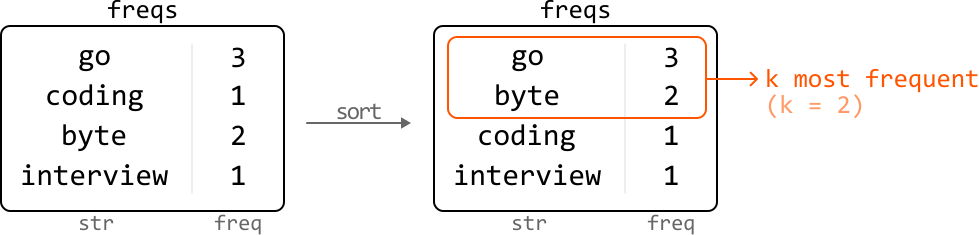
The main inefficiency of this solution is that it involves sorting all n strings, even though we only need the top k frequent ones to be sorted.
Something useful to consider: if we remove the most frequent string, the new most frequent string after this removal represents the second-most frequent overall. By repeatedly identifying and removing the most frequent string k times, we efficiently obtain our answer.
To implement this idea, we need a data structure that allows efficient access to the most frequent string at any time. A max-heap is perfect for this.
Max-heap
Let's find the k most frequent strings from the previous input, this time using a max-heap. First, populate the heap with each string along with their frequencies.
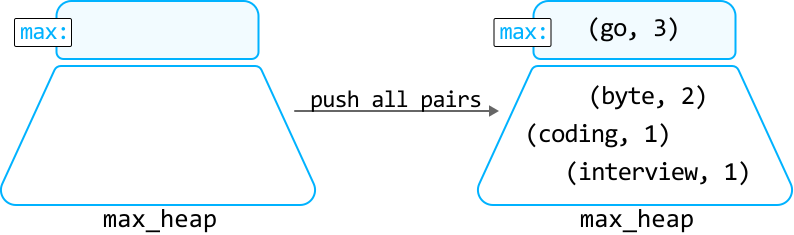
One way to populate the heap is to push all n strings into it one by one, which will take time. Instead, we can perform the heapify operation on an array containing all the string-frequency pairs to create the max-heap in time.
To collect the k most frequent strings, pop off the top element from the heap k times and store the corresponding strings in the output array res:
![Image represents a step-by-step visualization of a top-k frequent element algorithm with k=2. The process begins with a max-heap containing three elements: (go, 3), (byte, 2), and (coding, 1). The top element, (go, 3), is identified by a `max:` label and an arrow indicates it's popped from the heap and added to a result list `res`, which initially is empty. This results in a new max-heap containing (byte, 2), (coding, 1), and (interview, 1), and `res` now equals `[go]`. The next iteration identifies (byte, 2) as the maximum, pops it, and adds it to `res`, yielding a max-heap with (coding, 1) and (interview, 1), and `res` becoming `[go, byte]`. The algorithm stops here because k=2, and the final `res` list `[go, byte]` is returned, as indicated by an arrow labeled 'return'. Each max-heap is visually represented as a trapezoid, clearly showing its elements.](images/img-045f7e16e53c.svg)
Now, we just need to ensure that when two strings have the same frequency, the one that comes first lexicographically has a higher priority in the heap. To do this, we can define a custom comparator for the heap that prioritizes strings lexicographically when their frequencies match, as demonstrated in the implementation below.
We create a Pair class for string-frequency pairs, enabling us to customize priority using a custom comparator.
from typing import List
from collections import Counter
import heapq

class Pair:
   def __init__(self, str, freq):
       self.str = str
       self.freq = freq

   # Define a custom comparator.
   def __lt__(self, other):
       # Prioritize lexicographical order for strings with equal frequencies.
       if self.freq == other.freq:
           return self.str < other.str
       # Otherwise, prioritize strings with higher frequencies.
       return self.freq > other.freq

def k_most_frequent_strings_max_heap(strs: List[str], k: int) -> List[str]:
   # We use 'Counter' to create a hash map that counts the frequency of each string.
   freqs = Counter(strs)
   # Create the max heap by performing heapify on all string-frequency pairs.
   max_heap = [Pair(str, freq) for str, freq in freqs.items()]
   heapq.heapify(max_heap)
   # Pop the most frequent string off the heap 'k' times and return these 'k' most
   # frequent strings.
   return [heapq.heappop(max_heap).str for _ in range(k)]
struct Pair { string s; int freq; };
struct MaxCmp { // top() = highest freq; ties: lexicographically smaller
bool operator()(const Pair& a, const Pair& b) const {
if (a.freq != b.freq) {
return a.freq < b.freq; // lower freq = lower priority
}
return a.s > b.s; // tie: later letter = lower priority
}
};
vector<string> kMostFrequentStringsMaxHeap(vector<string>& strs, int k) {
unordered_map<string, int> freqs;
for (auto& s : strs) {
freqs[s]++;
}
vector<Pair> arr;
for (auto& [s, f] : freqs) {
arr.push_back({s, f});
}
priority_queue<Pair, vector<Pair>, MaxCmp> maxHeap(MaxCmp(), arr); // O(n) heapify
vector<string> res;
for (int i = 0; i < k; i++) {
res.push_back(maxHeap.top().s);
maxHeap.pop();
}
return res;
}static class Pair { String s; int freq; Pair(String s, int f){ this.s = s; this.freq = f; } }
List<String> kMostFrequentStringsMaxHeap(String[] strs, int k) {
Map<String,Integer> freqs = new HashMap<>();
for (String s : strs) freqs.merge(s, 1, Integer::sum);
// poll() returns the most important: highest freq, ties alphabetical
PriorityQueue<Pair> maxHeap = new PriorityQueue<>((a, b) ->
a.freq != b.freq ? b.freq - a.freq : a.s.compareTo(b.s));
for (Map.Entry<String,Integer> e : freqs.entrySet())
maxHeap.offer(new Pair(e.getKey(), e.getValue()));
List<String> res = new ArrayList<>();
for (int i = 0; i < k; i++) res.add(maxHeap.poll().s);
return res;
}Time complexity: The time complexity of k_most_frequent_strings_max_heap is .
Counter, and to build the max_heap.pop operation taking time.Therefore, the overall time complexity is .
Space complexity: The space complexity is because the hash map and heap store at most pairs. Note that the output array is not considered in the space complexity.
As a follow up, your interviewer may ask you to modify your solution to reduce the space used by the heap.
In the previous approach, we ended up storing up to n items in the heap. However, since we only need the k most frequent characters, is there a way to maintain a heap with a space complexity of ?
An important observation is that when our heap exceeds size k, we can discard the lowest frequency strings until the heap's size is reduced to k again. We can do this because those discarded strings definitely won't be among the k most frequent strings.
However, we can't implement this strategy with a max-heap because we won't have access to the lowest frequency string. Instead, we need to use a min-heap.
Let's observe how this works over an example:
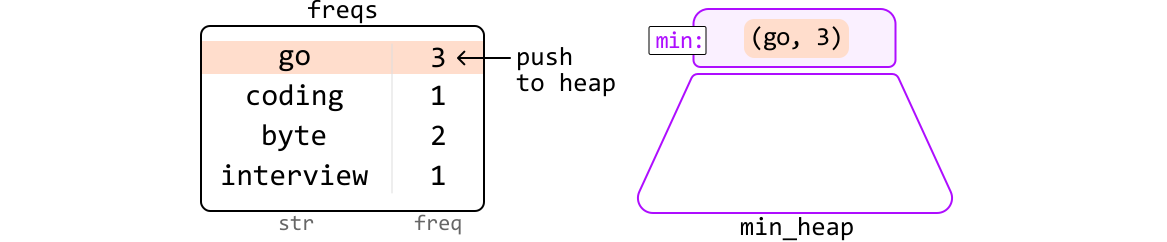
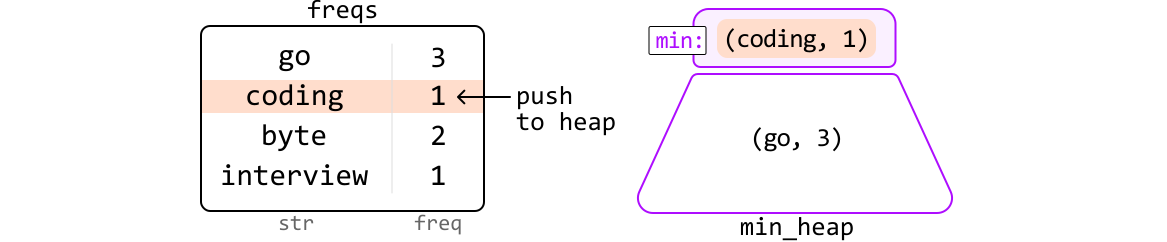
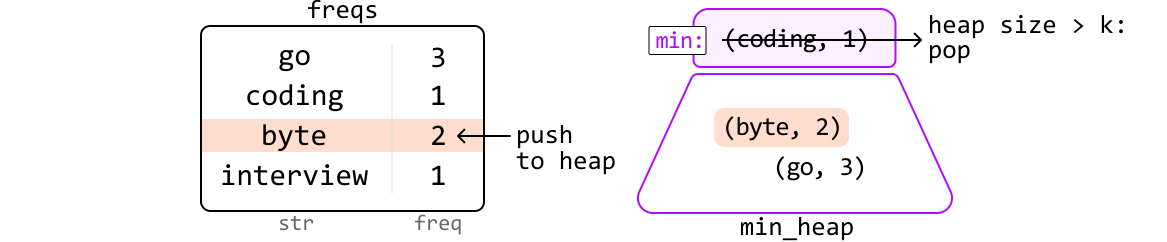
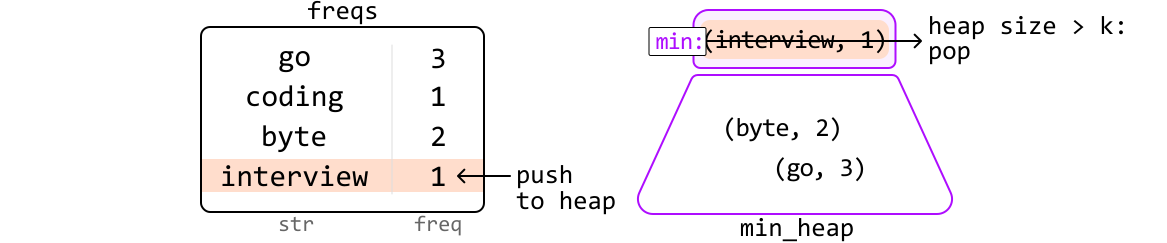
In the end, the strings remaining in the heap are our top k frequent strings:
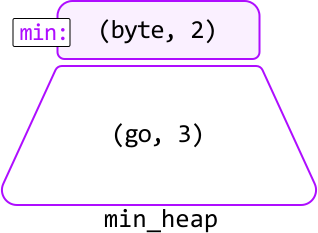
To retrieve these strings, pop them from the heap until it's empty. Because we're using a min-heap, we're popping off the less frequent strings first. So, we need to reverse the order of the retrieved strings before returning the result:
![Image represents a step-by-step visualization of a coding pattern, likely involving a min-heap data structure. The diagram shows three stages. Each stage features a purple, trapezoid-shaped min-heap, labeled 'min_heap,' containing pairs of elements. Above each min-heap is a purple rectangle labeled 'min:' followed by the minimum element currently at the top of the heap. In the first stage, the min-heap contains ('byte', 2) and ('go', 3). A horizontal arrow points from ('byte', 2) to a dashed-line rectangle below labeled 'res = [byte]', indicating that the minimum element ('byte', 2) is popped from the heap and added to a result list 'res'. The second stage shows the min-heap after this operation, containing only ('go', 3). The minimum element ('go', 3) is then popped and added to 'res', resulting in 'res = [byte, go]' in the second dashed-line rectangle. The third stage shows an empty min-heap and the final 'res = [byte, go]' list. A green arrow points from this final 'res' list to the text 'return reverse(res)', indicating that the algorithm concludes by returning the reversed version of the 'res' list.](images/img-2342cfb92067.svg)
from typing import List
from collections import Counter
import heapq

class Pair:
    def __init__(self, str, freq):
        self.str = str
        self.freq = freq
    # Since this is a min-heap comparator, we can use the same comparator as the one
    # used in the max-heap, but reversing the inequality signs to invert the priority.
    def __lt__(self, other):
        if self.freq == other.freq:
            return self.str > other.str
        return self.freq < other.freq

def k_most_frequent_strings_min_heap(strs: List[str], k: int) -> List[str]:
    freqs = Counter(strs)
    min_heap = []
    for str, freq in freqs.items():
        heapq.heappush(min_heap, Pair(str, freq))
        # If heap size exceeds 'k', pop the lowest frequency string to ensure the heap
        # only contains the 'k' most frequent words so far.
        if len(min_heap) > k:
            heapq.heappop(min_heap)
    # Return the 'k' most frequent strings by popping the remaining 'k' strings from
    # the heap. Since we're using a min-heap, we need to reverse the result after
    # popping the elements to ensure the most frequent strings are listed first.
    res = [heapq.heappop(min_heap).str for _ in range(k)]
    res.reverse()
    return res
struct MinCmp { // top() = LEAST important (first to be dropped)
bool operator()(const Pair& a, const Pair& b) const {
if (a.freq != b.freq) {
return a.freq > b.freq;
}
return a.s < b.s;
}
};
vector<string> kMostFrequentStringsMinHeap(vector<string>& strs, int k) {
unordered_map<string, int> freqs;
for (auto& s : strs) {
freqs[s]++;
}
priority_queue<Pair, vector<Pair>, MinCmp> minHeap;
for (auto& [s, f] : freqs) {
minHeap.push({s, f});
if ((int)minHeap.size() > k) {
minHeap.pop(); // keep only the k most frequent
}
}
vector<string> res;
while (!minHeap.empty()) {
res.push_back(minHeap.top().s);
minHeap.pop();
}
reverse(res.begin(), res.end());
return res;
}List<String> kMostFrequentStringsMinHeap(String[] strs, int k) {
Map<String,Integer> freqs = new HashMap<>();
for (String s : strs) freqs.merge(s, 1, Integer::sum);
// poll() returns the LEAST important (the one to discard); ties -> later letter
PriorityQueue<Pair> minHeap = new PriorityQueue<>((a, b) ->
a.freq != b.freq ? a.freq - b.freq : b.s.compareTo(a.s));
for (Map.Entry<String,Integer> e : freqs.entrySet()) {
minHeap.offer(new Pair(e.getKey(), e.getValue()));
if (minHeap.size() > k) minHeap.poll();
}
List<String> res = new ArrayList<>();
while (!minHeap.isEmpty()) res.add(minHeap.poll().s);
Collections.reverse(res);
return res;
}Time complexity: The time complexity of k_most_frequent_strings_min_heap is .
Counter.push and pop operation taking time. This takes time.pop operation times. This takes time.Therefore, the overall time complexity is .
Space complexity: The space complexity is because the hash map stores at most pairs, whereas the heap only takes up space. The res array is not considered in the space complexity.
Two step-by-step walkthroughs of the algorithm below: a valid case (the expected happy path) and an invalid / edge case that exercises the tricky parts. Each step shows the program state as the code runs—the same steps apply to Python, C++ and Java.
['go','coding','byte','byte','go','interview','go'], k = 2.heap top (about to pop) popped into answer
Step 1: count. Step 2: heapify into a max-heap. Step 3: pop twice.
counts: go:3, byte:2, coding:1, interview:1. A max-heap orders by higher frequency first, ties broken A–Z; the top is the most important:
go(3), the biggest count. Take it. The last leaf moves up and the heap re-settles so byte(2) becomes the new top.
byte(2). Take it. We have popped k = 2 strings, so we stop.
| pop # | heap top returned | why it’s the top | answer so far |
|---|---|---|---|
| 1 | go (freq 3) | highest frequency | [go] |
| 2 | byte (freq 2) | next highest frequency | [go, byte] |
['a','a','b','b','c'], k = 2.heap top (about to pop) popped into answer what a broken tie-break would do
Here a and b both appear twice — frequency alone cannot separate them.
counts: a:2, b:2, c:1. Ties broken A–Z, so a outranks b and sits on top:
a and b tie at freq 2, but 'a' < 'b', so a is on top. Take a.
b(2). Take b. Answer [a, b].
| pop # | returned | tie decided by | answer so far |
|---|---|---|---|
| 1 | a (freq 2) | 'a' < 'b' | [a] |
| 2 | b (freq 2) | next after a | [a, b] |
If you forgot the tie-break, the heap order between a and b is undefined — you might return [b, a], which is wrong. | |||
heapq is a min-heap, so Pair.__lt__ is written backwards: the most important pair looks “smallest” and floats to heap[0]. heapq.heapify builds it in O(n); heappop takes the top.
priority_queue is a max-heap driven by MaxCmp. The constructor priority_queue(cmp, vec) heapifies the vector in O(n); top()/pop() give and remove the most important pair.
PriorityQueue with a lambda comparator so poll() returns the most important pair. (Java builds via offer in O(n log n) rather than an O(n) heapify — see the note below.)