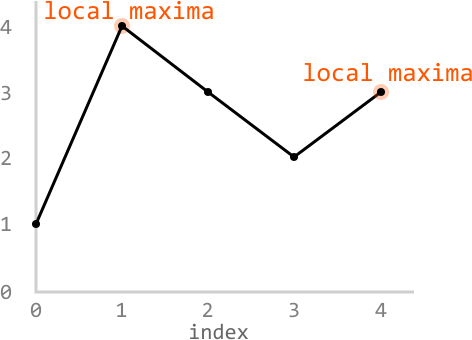
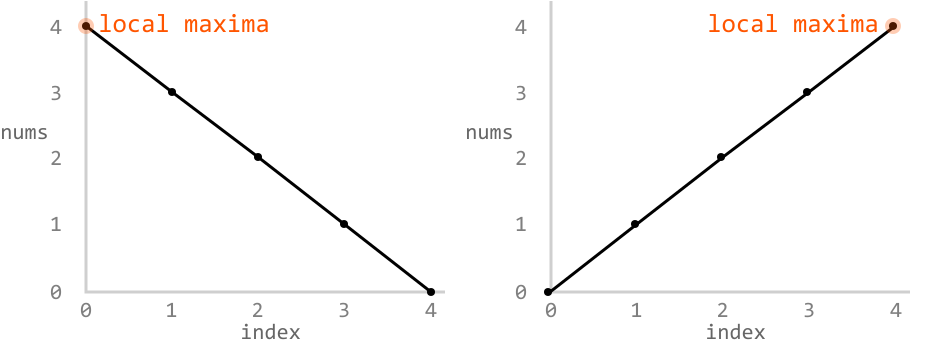
A local maxima is a value greater than both its immediate neighbors. Return any local maxima in an array. You may assume that an element is always considered to be strictly greater than a neighbor that is outside the array.
Example:
Input: nums = [1, 4, 3, 2, 3]
Output: 1# index 4 is also acceptable
Constraints:
No two adjacent elements in the array are equal.
In Plain English
New to this one? Start here. Below is the core idea in everyday language, plus a real-world analogy—then the sections that follow build on it with the formal reasoning, code, and step-by-step walkthroughs.
🌱 A real-world picture: hiking uphill in fog
You're on a trail in thick fog and want to reach a summit — not necessarily the tallest. You can only feel whether the ground rises or falls right next to you. Rule: always step toward the higher side. Keep doing that and you must arrive somewhere both sides drop away — a peak. You never had to see the whole mountain.
Intuition
A naive way to solve this problem is to linearly search for a local maxima by iteratively comparing each value to its neighbors and returning the first local maxima we find. A linear solution isn't terrible, but since we can return any maxima, there’s likely a more efficient approach.
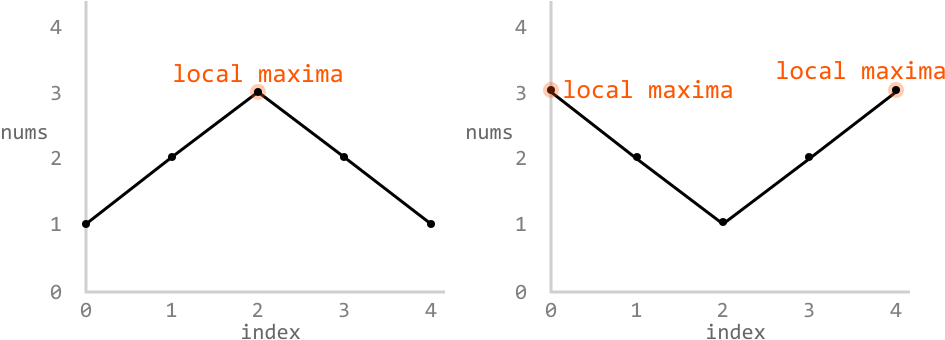
The first important thing to notice is that since this is an array with no adjacent duplicates, it will always contain at least one local maxima. If it's not at one of the edges of the array, there'll be at least one somewhere in the middle:
Now, let's say we're at some random index in the array, index i. An interesting observation is that if the next number (at index i + 1) is greater than the current, there’s definitely a local maxima somewhere to the right of i. This is because the two points at index i and i + 1 form an ascending slope, and this slope would be heading upwards towards some maxima:
The opposite applies if points i and i + 1 form a descending slope. This would imply a maxima exists somewhere to the left or at i. Notice here that the point at index i itself could be a maxima too:
Once we know whether a local maxima exists to the left or to the right, we can continue searching in that direction until we find it. In other words, we narrow our search toward the direction of the maxima. Doesn't this type of reasoning sound similar to how we narrow search space in a binary search? This indicates that it might be possible to find a local maxima using binary search.
Binary search
First, let’s define the search space. A local maxima could exist at any index of the array. So, the search space should encompass the entire array.
To figure out how we narrow the search space, let’s use the below example, setting left and right pointers at the boundaries of the array:
The midpoint is initially set at index 3, which forms a descending slope with its right neighbor since nums[mid] > nums[mid + 1]. This suggests that either a maxima exists to the left of index 3 or that index 3 itself is a maxima). So, we should continue our search to the left, while including the midpoint in the search space:
The next midpoint is set at index 1, which forms an ascending slope with its right neighbor since nums[mid] < nums[mid + 1]. This suggests that a maxima exists somewhere to the right of the midpoint. So, let’s continue the search to the right, while excluding the midpoint:
The next midpoint is set at index 2, which forms a descending slope with its right neighbor. So, we continue by searching to the left, while including the midpoint:
Now that the left and right pointers have met, locating index 2 as a local maxima, we return this maxima’s index (left).
Summary
Case 1: The midpoint forms a descending slope with its right neighbor, indicating the midpoint is a local maxima, or that a local maxima exists to the left. Narrow the search space toward the left while including the midpoint:
Case 2: The midpoint forms an ascending slope with its right neighbor, indicating a local maxima exists to the right. Narrow the search space toward the right while excluding the midpoint:
Implementation
from typing import List

def local_maxima_in_array(nums: List[int]) -> int:
    left, right = 0, len(nums) - 1
    while left < right:
        mid = (left + right) // 2
        if nums[mid] > nums[mid + 1]:
            right = mid
        else:
            left = mid + 1
    return left
int localMaximaInArray(vector<int>& nums) {
    int left = 0, right = (int)nums.size() - 1;
    while (left < right) {
        int mid = left + (right - left) / 2;
        if (nums[mid] < nums[mid + 1]) {
            left = mid + 1;          // rising -> a peak is to the right
        } else {
            right = mid;             // falling -> peak at mid or to the left
        }
    }
    return left;                     // left == right -> a peak
}
public int localMaximaInArray(int[] nums) {
    int left = 0, right = nums.length - 1;
    while (left < right) {
        int mid = left + (right - left) / 2;
        if (nums[mid] < nums[mid + 1]) {
            left = mid + 1;          // rising -> a peak is to the right
        } else {
            right = mid;             // falling -> peak at mid or to the left
        }
    }
    return left;                     // left == right -> a peak
}
Complexity Analysis
Time complexity: The time complexity of local_maxima_in_array is O(log(n)), where n denotes the length of the array. This is because we use binary search to find a local maxima.
Space complexity: The space complexity is O(1).
Dry Runs
Two step-by-step walkthroughs of the algorithm below: a valid case (the expected happy path) and an invalid / edge case that exercises the tricky parts. Each step shows the program state as the code runs—the same steps apply to Python, C++ and Java.
✅ Dry run 1 (valid) — [1, 5, 7, 9, 4, 3, 8, 6]. The search lands on index 3 (value 9), an interior peak.
left mid right peak thrown away
Step 1. mid=3 (value 9). nums[3]=9 < nums[4]=4? No → falling, go left: right = 3.
1L
5
7
9M
4
3
8
6R
Step 2. left=0, right=3, mid=1 (value 5). nums[1]=5 < nums[2]=7 → rising, go right: left = 2.
1L
5M
7
9R
4
3
8
6
Step 3. left=2, right=3, mid=2 (value 7). nums[2]=7 < nums[3]=9 → rising, go right: left = 3.
1
5
7ML
9R
4
3
8
6
Step 4. left == right == 3. Return 3 — value 9 is a peak (9 > its neighbors 7 and 4). 🎉
1
5
7
9★
4
3
8
6
The same run as a table
left
right
mid
nums[mid]
nums[mid+1]
action
0
7
3
9
4
falling → right = 3
0
3
1
5
7
rising → left = 2
2
3
2
7
9
rising → left = 3
3
3
—
—
—
return 3
Note there's another peak at index 6 (value 8) — returning any peak is fine. This run happened to climb to index 3.
⚠️ Dry run 2 (edge) — [1, 2, 3, 4, 5, 6, 7] only ever rises. There's no interior hill, so the peak is the last element (index 6).
left mid right peak thrown away
Step 1. mid=3 (value 4). nums[3]=4 < nums[4]=5 → rising, go right: left = 4.
1L
2
3
4M
5
6
7R
Step 2. left=4, right=6, mid=5 (value 6). nums[5]=6 < nums[6]=7 → rising, go right: left = 6.
1
2
3
4
5L
6M
7R
Step 3. left == right == 6. Return 6 — the array never fell, so the imaginary −∞ wall past the end makes the last element (7) a peak. 🎉
1
2
3
4
5
6
7★
The same run as a table
left
right
mid
nums[mid]
nums[mid+1]
action
0
6
3
4
5
rising → left = 4
4
6
5
6
7
rising → left = 6
6
6
—
—
—
return 6
This is the case beginners fear (“what if there's no peak?”). Because right = mid keeps the top candidate and the edges act like −∞ walls, an always-rising array simply converges on its final index — always a valid peak.
The same steps in each language
The steps match the tables above. There's no target here — each step just compares nums[mid] with nums[mid + 1]. Python uses len(nums) for the right bound.
Identical logic; only the length accessor differs: (int)nums.size().
Identical logic; only the length accessor differs: nums.length.
![Image represents a diagram illustrating a condition within a coding pattern, likely related to finding local maxima in an array. Two orange circles represent array indices 'i' and 'i+1', with downward-pointing orange arrows indicating access to the corresponding array elements `nums[i]` and `nums[i+1]`. A thick black line connects the circle representing 'i' to a black dot representing an intermediate state. A dashed line extends from this dot, suggesting a continuation. An orange arrow points from 'i+1' to this black dot. The text `nums[i] < nums[i+1]` indicates a comparison between the values at these indices. A rightward arrow follows this comparison, leading to the text 'local maxima somewhere to the right of i,' implying that if the condition `nums[i] < nums[i+1]` is true, a local maximum is expected to exist at some index greater than 'i'. The overall diagram visually represents the logic flow of checking for an increasing trend in the array to potentially identify a local maximum.](images/img-016ebda6849d.svg)
![Image represents a diagram illustrating a condition for identifying local maxima within a numerical sequence represented by the array `nums`. The diagram features two nodes, one colored orange and the other black, connected by a solid black arrow pointing from the orange node to the black node. Above the orange node, a downward-pointing orange arrow labeled 'i' indicates an index `i` in the `nums` array. Similarly, a downward-pointing orange arrow labeled 'i+1' points to the black node, representing the next index `i+1`. A dashed line extends from a point slightly to the left and above the orange node, suggesting a continuation of the sequence before index `i`. The core logic is expressed as `nums[i] > nums[i+1]`, indicating that if the value at index `i` is greater than the value at index `i+1`, then either a local maximum exists somewhere to the left of index `i`, or the value at `nums[i]` itself is a local maximum. The text to the right of the inequality explains these two possible outcomes.](images/img-6a571b18f1b6.svg)
![Image represents a line graph illustrating a numerical array. The horizontal axis is labeled 'index' and ranges from 0 to 6. The vertical axis is labeled 'nums' and ranges from 0 to 4. A black line connects data points representing the values of an array [0, 1, 4, 2, 1, 2, 3], where each number corresponds to its index. The array is displayed above the graph. Two orange vertical lines highlight the leftmost (index 0, value 0) and rightmost (index 6, value 3) elements of the array. Above these lines, orange rectangular boxes labeled 'left' and 'right' respectively, indicate the boundaries. The area under the line graph is filled with a light peach color.](images/img-f5cd0f65ac5f.svg)
![Image represents two line graphs illustrating a coding pattern, likely a binary search algorithm. Both graphs display the same data points: `[0, 1, 4, 2, 1, 2, 3]` plotted against an index from 0 to 6. The y-axis represents the 'nums' values. In both graphs, vertical orange lines mark 'left' and 'right' boundaries, and a light-blue arrow indicates 'mid'. The left graph shows the initial state with 'left' at index 0, 'mid' at index 3, and 'right' at index 6. A shaded peach area highlights the section between 'left' and 'right'. The right graph depicts an iteration where a descending slope is detected (nums[mid] > nums[mid + 1]), resulting in 'right' being updated to the 'mid' index (index 3). A dashed orange line connects the old and new 'right' positions. A grey box in the left graph explains the condition for updating 'right' in the algorithm: `descending slope: nums[mid] > nums[mid + 1] → right = mid`. A small arrow points from this box to the right graph, indicating the application of this rule.](images/img-9677ceeb6c54.svg)
![Image represents a visual explanation of a coding pattern, likely within a sorting or searching algorithm. The image is divided into two nearly identical parts, each showing a line graph with a series of points connected by lines. The x-axis represents an index (0-6), and the y-axis represents numerical values ('nums'). In both parts, orange vertical lines highlight sections of the graph. Above each graph, rectangular boxes labeled 'left,' 'mid,' and 'right' indicate index values (e.g., [0 1 4 2 1 2 3] in the first part) that are associated with the graph's points. Arrows point from these boxes down to their corresponding points on the graph. A dashed gray line connects the 'left' and 'right' indices in the second part, suggesting a range. A light peach-colored rectangle highlights a section of the graph between the 'left' and 'right' markers. A separate box explains the condition 'ascending slope: nums[mid] < nums[mid + 1] → left = mid + 1,' indicating that if the value at the midpoint is less than the value at the next point, the 'left' index is updated to the midpoint plus one. This suggests an iterative process of narrowing down a search range based on the slope of the line graph. The two parts likely illustrate different stages of this iterative process.](images/img-12de53c8361b.svg)
![Image represents a visual explanation of a coding pattern, likely within a binary search algorithm. The image is divided into two nearly identical halves, each showing a line graph plotting a numerical array `nums` against its index. The x-axis represents the index (0 to 6), and the y-axis represents the values within the `nums` array. Both graphs depict the same data, a series of points connected by lines forming a V-shape. At the top of each half, labeled boxes indicate pointers `left`, `mid`, and `right`, initially pointing to indices 0, 2, and 3 respectively in the left half and 0, 1, and 3 in the right half. These pointers define a search window within the array. A shaded orange vertical bar highlights the `mid` index in the left graph. A gray box in the left half explains a condition: 'descending slope: nums[mid] > nums[mid + 1] → right = mid,' indicating that if the value at `mid` is greater than the value at `mid + 1`, the `right` pointer is updated to `mid`, effectively narrowing the search space. The right half likely shows the result of applying this condition, with the `right` pointer moved to index 1. The overall diagram illustrates how the algorithm iteratively refines the search range based on the slope of the data.](images/img-579a27fa793a.svg)
![Image represents a visual explanation of a step within a binary search algorithm, specifically illustrating a condition where the middle element is greater than the element to its right. The image is divided into two parts separated by a large right-pointing arrow. The left part shows an array `[0, 4, 3, 1, 0]` represented graphically as a line graph with the x-axis representing the index (0 to 4) and the y-axis representing the array's values (0 to 4). Vertical orange lines mark the `left` (index 0), `mid` (index 2), and `right` (index 4) pointers, with corresponding labels above the lines. A shaded peach area highlights the section of the array between `left` and `right`. A black line connects the data points, showing the array's values. The right part shows the updated state after the condition `if nums[mid] > nums[mid + 1]: right = mid;` is executed. The `right` pointer has moved from index 4 to index 2, indicated by a dashed orange line connecting the old and new positions. The graph is updated to reflect this change, with the new `right` pointer at index 2. Above both parts, a code snippet displays the condition `if nums[mid] > nums[mid + 1]: right = mid;`, which is the decision-making logic behind the pointer movement. The overall image demonstrates how the algorithm adjusts its search space based on the comparison of the middle element with its neighbor to the right.](images/img-e6ae8b8ed046.svg)
![Image represents a visual explanation of a coding pattern, likely within a sorting algorithm. The top shows a code snippet: `if nums[mid] < nums[mid + 1]: left = mid + 1;`, indicating a conditional statement comparing two elements of an array `nums` at indices `mid` and `mid + 1`. Below, a line graph displays an array `nums` = [0, 4, 3, 1, 0] with indices 0-4 on the x-axis and values on the y-axis. Orange vertical lines mark `left` (index 0), `mid` (index 2), and `right` (index 4), initially. A shaded peach region highlights the section between `left` and `right`. A black line connects the data points. A grey dot marks the `mid` point's value. A thick black arrow separates this from a second graph showing the array after the conditional statement's execution. In the second graph, `left` has shifted to index 3, indicated by a new orange line, while `right` remains at index 4. The peach shaded region now reflects the updated `left` and `right` boundaries. The dashed orange line connects the old and new `left` positions, visually demonstrating the shift. The second graph's line plot remains the same, but the `left` pointer's position has changed, illustrating the algorithm's step in adjusting the search space based on the comparison.](images/img-a84bd5fe833a.svg)