Design and implement a data structure for the Least Recently Used (LRU) cache that supports the following operations:
LRUCache(capacity: int): Initialize an LRU cache with the specified capacity.get(key: int) -> int: Return the value associated with a key. Return -1 if the key doesn't exist.put(key: int, value: int) -> None: Add a key and its value to the cache. If adding the key would result in the cache exceeding its size capacity, evict the least recently used element. If the key already exists in the cache, update its value.Input: [
put(1, 100),
put(2, 250),
get(2),
put(4, 300),
put(3, 200),
get(4),
get(1),
],
capacity = 3
Output: [250, 300, -1]
Explanation:
put(1, 100)  # cache is[1: 100]
put(2, 250)  # cache is[1: 100, 2: 250]
get(2)       # return 250
put(4, 300)  # cache is[1: 100, 2: 250, 4: 300]t
put(3, 200)  # cache is[2: 250, 4: 300, 3: 200]
get(4)       # return 300
get(1)       # key 1 was evicted when adding key 3 due to the capacity
             # limit: return -1
All keys and values are positive integers.
The cache capacity is positive.
New to this one? Start here. Below is the core idea in everyday language, plus a real-world analogy—then the sections that follow build on it with the formal reasoning, code, and step-by-step walkthroughs.
Your desk fits only a few books. Each time you use a book you put it back on top of the pile. When you bring a new book but the desk is full, you toss the one at the bottom — the one you haven't touched in the longest time. The desk is the cache, “on top” is most-recently-used, and the bottom book is the eviction victim.
When presented with a design problem, the first steps usually involve understanding the problem and deciding which data structures to use. Let's start by understanding how an LRU cache works at a high level.
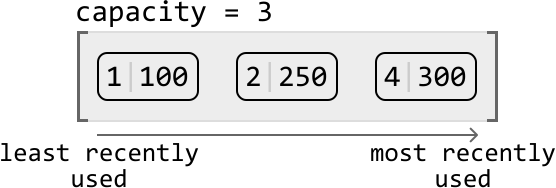
Consider the LRU cache described below. It currently holds 3 elements and has reached full capacity. Assume that in this representation, the key-value pairs are ordered from the least recently used (left) to the most recently used (right):
Let's try putting a new key-value pair into the cache:
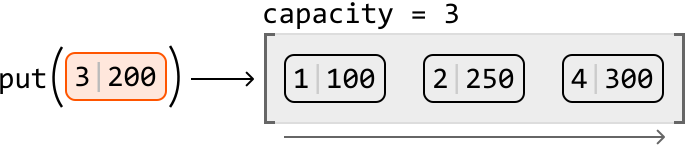
This new pair would effectively be the most recent in the cache, so we know it should be added at the most-recently-used end of the cache. Since the cache is currently at maximum capacity, we need to make room for the new pair by first evicting the least recently used pair:
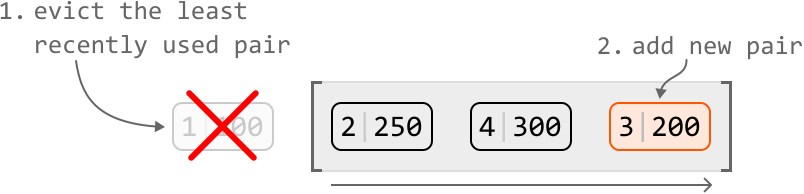
From this high-level overview, we can summarize operations we need to implement the put function:
Remove a key-value pair from the least recently used end of the cache.
Add a key-value pair to the most recently used end of the cache.
Now, let's try retrieving a value from this example cache. If we perform get(2), we expect it to return 250. Accessing this pair would effectively make it the most recently used pair. So, we should move it to the most recently used end of the cache:
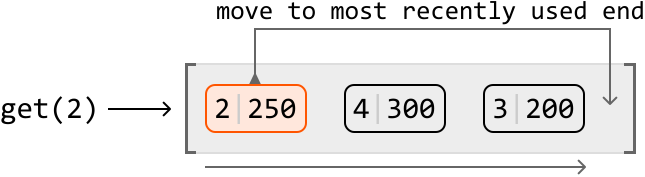

From this example, we identified two key operations for the get function:
Move a key-value pair to the most recent end of the cache.
Access a value using its key.
We’ve now narrowed the design down to the four main operations listed above. These will help us identify which data structures we can employ to design the LRU cache.
Choosing data structures
The first two operations involve adding and removing key-value pairs. Specifically, we need the ability to remove a key-value pair from one end of a data structure (representing the least recently used end) and add a key-value pair to the other.
Which data structure allows us to efficiently add or remove an element from it? A suitable data structure for these operations is a linked list, particularly because we can add and remove a node in constant time if we have a reference to that node. But should we use a singly or doubly linked list?
Adding or removing a node from the head of a linked list takes time, whether it’s a singly or doubly linked list. However, removing the tail node from a singly linked list takes time, even with a reference to the tail, because we need to traverse the list to access the node before the tail. In contrast, a doubly linked list allows removal of the tail because each node has a reference to its previous node, enabling direct access without traversal. So, let’s choose the doubly linked list.
An important feature we need is the ability to access both ends of the doubly linked list when adding or removing nodes. With this in mind, let's establish some definitions:
To reference the ends of the linked list, we can establish head and tail nodes, where head points to the least recently used node, and tail points to the most recently used node:

Operation 3 indicates that we’ll need to be able to move a node to the most recently-used end of the cache, and that this node doesn’t necessarily need to be at the head or tail of the linked list. If this node was somewhere in the middle, we’d need to traverse the linked list to find it. Is there a way we could access this node in time? Since this node is associated with a key, we could use a hash map to store key-node pairs. This allows us to access a node by its key in constant time. The diagram below illustrates how the hash map's values are references to nodes in the linked list:

Using a hash map also addresses operation 4 regarding efficient access to values from their keys.
Now we’ve decided on using a doubly linked list and a hash map to represent the LRU cache, let’s examine how the put and get functions would be implemented.
put(key: int, val: int) -> None:
Below is the flow for adding a new key-value pair to the cache. This involves correctly updating the linked list and the hash map, while ensuring the cache does not exceed its capacity:
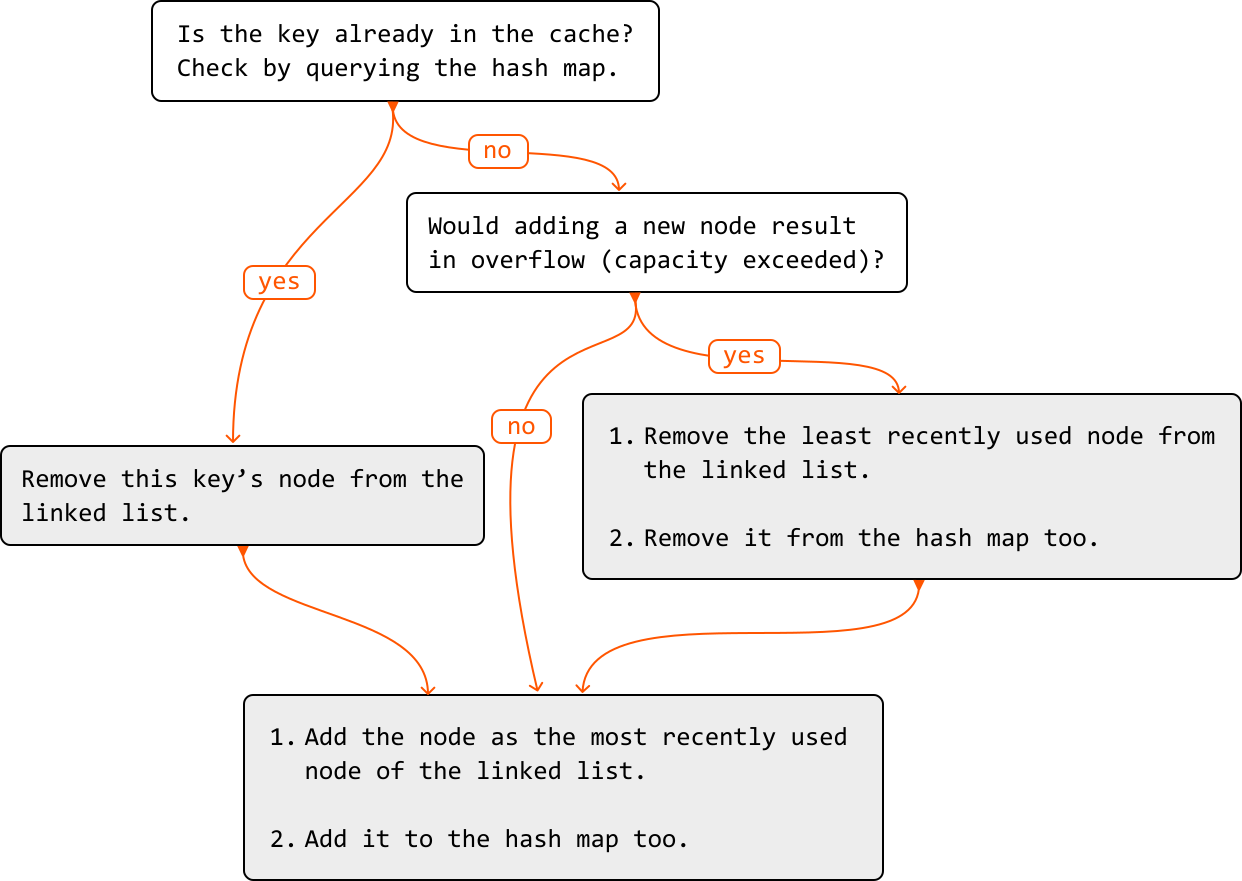
To better understand how to add a new node to a doubly linked list that’s at maximum capacity, check out the following example:
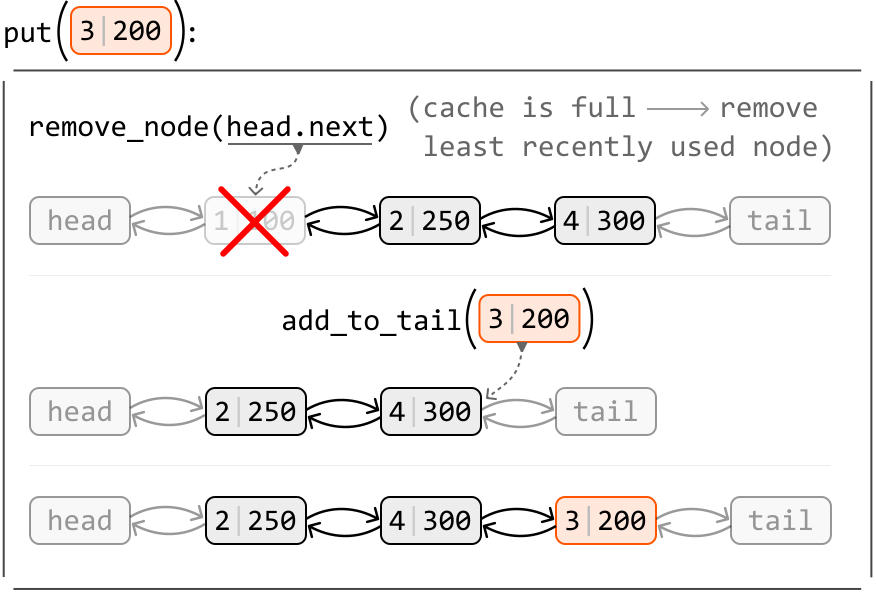
As you can see, we’ll need a function to remove a node (remove_node), as well as a function to add a node to the tail of the linked list (add_to_tail). We discuss these functions in more detail in the implementation section.
get(key: int) -> int:
Below is the process for retrieving a key's value from the cache:
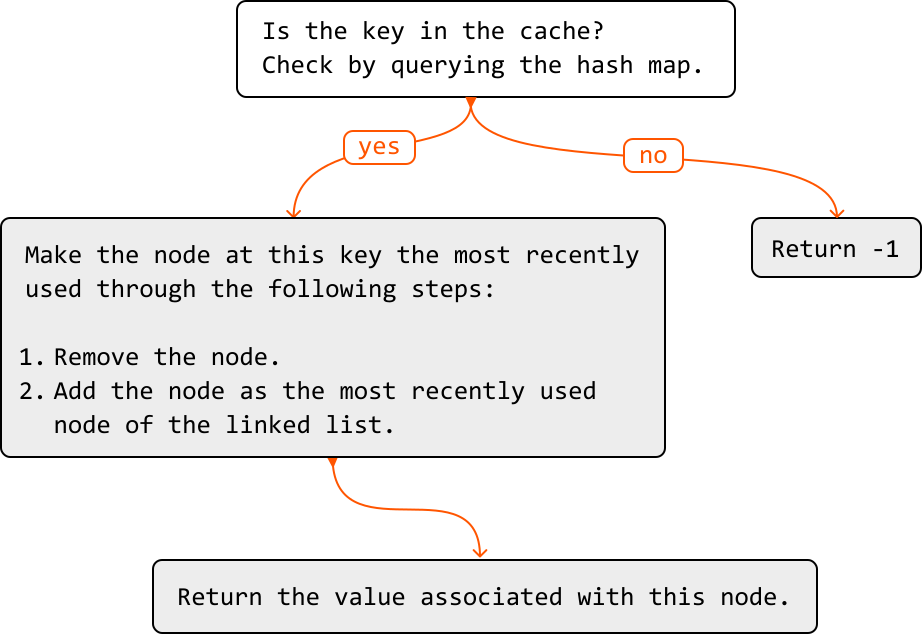
Now let’s take a look at an example of how the doubly linked list is updated during a get function call:
![Image represents a visual depiction of a `get(2)` operation on a doubly linked list, implemented using a hashmap for efficient node access. The top section shows the initial state: a doubly linked list with nodes labeled '2 | 250', '4 | 300', and '3 | 200', connected by bidirectional arrows indicating `next` and `prev` pointers. 'head' and 'tail' labels point to the beginning and end of the list, respectively. A dashed arrow points from `remove_node(hashmap[2])` to node '2 | 250', which is marked with a red 'X', signifying its removal. The middle section illustrates the removal of node '2 | 250'. The bottom section shows the node '2 | 250' re-added to the tail of the list via `add_to_tail(2 | 250)`, indicated by a dashed arrow. Finally, a thick black arrow at the bottom points to 'return 250', indicating the value returned by the `get(2)` operation after the node has been temporarily removed and then re-added to the tail. Each node displays a key-value pair (e.g., '2 | 250'), representing the key used in the hashmap and the associated value. The overall diagram demonstrates the process of retrieving a node's value, removing it, and then re-inserting it at the tail to maintain the list's structure.](images/img-bcc8d1416f76.svg)
Now that we understand how the doubly linked list and hash map are used to design the LRU cache, let's dive into its implementation details, including the details of the helper methods remove_node and add_to_tail.
We can use the custom class below to represent a node in a doubly linked list:
class DoublyLinkedListNode:
   def __init__(self, key: int, val: int):
       self.key = key
       self.val = val
       self.next = self.prev = None
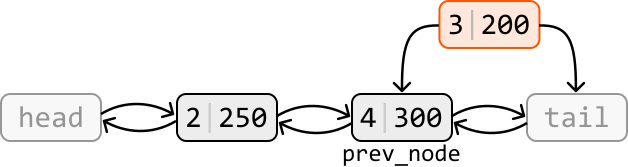
The example below illustrates how to add a node to the tail of the linked list. Let's refer to the node before the tail as prev_node.
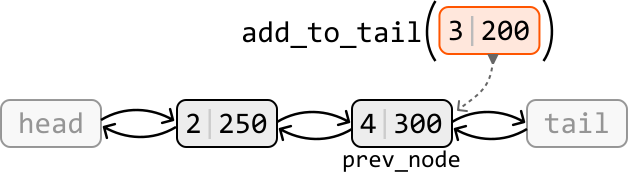
The new node should appear after prev_node and before the tail node. Let’s set the new node’s prev and next pointers to reflect this:
Now connect prev_node and tail to the new node:
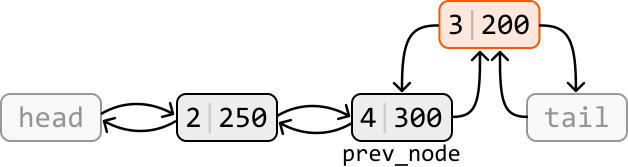
Below is the implementation of this function:
def add_to_tail(self, node: DoublyLinkedListNode) -> None:
    prev_node = self.tail.prev
    node.prev = prev_node
    node.next = self.tail
    prev_node.next = node
    self.tail.prev = node
The example below illustrates how to remove a node from the doubly linked list:
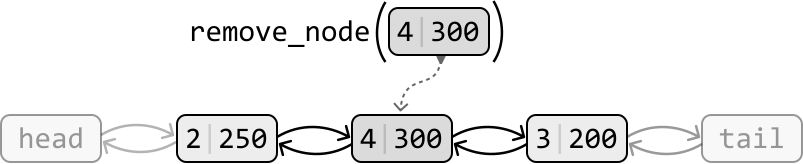
To remove a node, we make its two adjacent nodes point at each other, effectively excluding the node to be removed from the linked list:

Below is the implementation of this function:
def remove_node(self, node: DoublyLinkedListNode) -> None:
    node.prev.next = node.next
    node.next.prev = node.prev
With the help of the above two functions, we can complete the full implementation of the LRU cache.
LRU Cache
class DoublyLinkedListNode:
    def __init__(self, key: int, val: int):
        self.key = key
        self.val = val
        self.next = self.prev = None

class LRUCache:
    def __init__(self, capacity: int):
        self.capacity = capacity
        # A hash map that maps keys to nodes.
        self.hashmap = {}
        # Initialize the head and tail dummy nodes and connect them to
        # each other to establish a basic two-node doubly linked list.
        self.head = DoublyLinkedListNode(-1, -1)
        self.tail = DoublyLinkedListNode(-1, -1)
        self.head.next = self.tail
        self.tail.prev = self.head

    def get(self, key: int) -> int:
        if key not in self.hashmap:
            return -1
        # To make this key the most recently used, remove its node and
        # re-add it to the tail of the linked list.
        self.remove_node(self.hashmap[key])
        self.add_to_tail(self.hashmap[key])
        return self.hashmap[key].val

    def put(self, key: int, value: int) -> None:
        # If a node with this key already exists, remove it from the
        # linked list.
        if key in self.hashmap:
            self.remove_node(self.hashmap[key])
        node = DoublyLinkedListNode(key, value)
        self.hashmap[key] = node
        # Remove the least recently used node from the cache if adding
        # this new node will result in an overflow.
        if len(self.hashmap) > self.capacity:
            del self.hashmap[self.head.next.key]
            self.remove_node(self.head.next)
        self.add_to_tail(node)

    def add_to_tail(self, node: DoublyLinkedListNode) -> None:
        prev_node = self.tail.prev
        node.prev = prev_node
        node.next = self.tail
        prev_node.next = node
        self.tail.prev = node

    def remove_node(self, node: DoublyLinkedListNode) -> None:
        node.prev.next = node.next
        node.next.prev = node.prev
#include <unordered_map>
using namespace std;
struct Node {
int key, val;
Node* prev;
Node* next;
Node(int k, int v) : key(k), val(v), prev(nullptr), next(nullptr) {}
};
class LRUCache {
int cap;
unordered_map<int, Node*> map; // key -> Node
Node* head; // dummy: most-recent side
Node* tail; // dummy: least-recent side
void remove(Node* node) { // unlink a node
node->prev->next = node->next;
node->next->prev = node->prev;
}
void addFront(Node* node) { // insert right after head (MRU)
node->next = head->next;
node->prev = head;
head->next->prev = node;
head->next = node;
}
public:
LRUCache(int capacity) : cap(capacity) {
head = new Node(0, 0);
tail = new Node(0, 0);
head->next = tail;
tail->prev = head;
}
int get(int key) {
if (map.count(key) == 0) {
return -1;
}
Node* node = map[key];
remove(node); // touch: move to front
addFront(node);
return node->val;
}
void put(int key, int value) {
if (map.count(key) > 0) { // replace any old node
Node* old = map[key];
remove(old);
delete old;
}
Node* node = new Node(key, value);
map[key] = node;
addFront(node);
if ((int)map.size() > cap) { // over capacity -> evict LRU
Node* lru = tail->prev;
remove(lru);
map.erase(lru->key);
delete lru;
}
}
};import java.util.*;
class LRUCache {
class Node {
int key, val;
Node prev, next;
Node(int k, int v) { key = k; val = v; }
}
private int cap;
private Map<Integer, Node> map = new HashMap<>(); // key -> Node
private Node head, tail; // dummy ends
public LRUCache(int capacity) {
cap = capacity;
head = new Node(0, 0); // most-recent side
tail = new Node(0, 0); // least-recent side
head.next = tail;
tail.prev = head;
}
private void remove(Node node) { // unlink a node
node.prev.next = node.next;
node.next.prev = node.prev;
}
private void addFront(Node node) { // insert right after head (MRU)
node.next = head.next;
node.prev = head;
head.next.prev = node;
head.next = node;
}
public int get(int key) {
if (!map.containsKey(key)) return -1;
Node node = map.get(key);
remove(node); // touch: move to front
addFront(node);
return node.val;
}
public void put(int key, int value) {
if (map.containsKey(key)) { // replace any old node
remove(map.get(key));
}
Node node = new Node(key, value);
map.put(key, node);
addFront(node);
if (map.size() > cap) { // over capacity -> evict LRU
Node lru = tail.prev;
remove(lru);
map.remove(lru.key);
}
}
}Time complexity: The time complexity for the helper functions remove_node and add_tail_node is because they perform constant-time operations on a doubly linked list. The put and get functions utilize these helper functions, while also performing constant-time hash map operations. Consequently, they also have an time complexity.
Space complexity: The overall space complexity of this solution is , where is the capacity of the cache. This is because both the doubly linked list and hash map can each occupy space.
Tip: Explore how combining data structures can help achieve certain functionality.
It’s possible to encounter situations where no single data structure provides the functionality required for your solution. In such cases, try to work out if this functionality can be achieved using a combination of data structures. For instance, in this problem we combined a doubly-linked list and a hash map to achieve the functionality required for the LRU cache.
Two step-by-step walkthroughs of the algorithm below: a valid case (the expected happy path) and an invalid / edge case that exercises the tricky parts. Each step shows the program state as the code runs—the same steps apply to Python, C++ and Java.
most recently used least recently used (evict next)
| Operation | Returns | Order after (MRU…LRU) | Evicted |
|---|---|---|---|
| put(1,1) | — | 1 | — |
| put(2,2) | — | 2, 1 | — |
| get(1) | 1 | 1, 2 | — |
| put(3,3) | — | 3, 1 | 2 |
| get(2) | -1 | 3, 1 | — |
| put(4,4) | — | 4, 3 | 1 |
| get(3) | 3 | 3, 4 | — |
| get(4) | 4 | 4, 3 | — |
the one cached entry (both MRU and LRU) evicted
| Operation | Returns | Order after | Evicted |
|---|---|---|---|
| put(1,10) | — | 1 | — |
| put(2,20) | — | 2 | 1 |
| get(1) | -1 | 2 | — |
| put(2,99) | — | 2 (value 20→99) | — |
| get(2) | 99 | 2 | — |
Contrast with Dry run 1: capacity 1 means every distinct new key forces an eviction. And put(2,99) on an existing key replaces the value and re-inserts at the front, but the size stays 1 so nothing is evicted — the “update, don't grow” case that trips up many first attempts.
Both runs step exactly as the tables above. Python: a miss is key not in self.map → return -1; an existing-key put does _remove(self.map[key]) before inserting the fresh node; eviction reads lru = self.tail.prev and del self.map[lru.key].
Same steps. C++: a miss is map.count(key) == 0; existing-key put calls remove(old); delete old;; eviction does map.erase(lru->key); delete lru;.
Same steps. Java: a miss is !map.containsKey(key); existing-key put calls remove(map.get(key)); eviction does map.remove(lru.key).