Intuition

This chapter tackles several problems relating to important math and geometry concepts in programming, which regularly appear in technical interviews.

We explore subjects such as:

Real-world Example

Computer graphics: In 3D rendering, geometry is used to represent objects as shapes like polygons, and mathematical transformations such as rotation, scaling, and translation, are applied to these objects to animate them, or change their perspective. Algorithms that use trigonometry, vector math, and matrix operations, are critical for determining how objects move, interact with light, or cast shadows in virtual environments.

Chapter Outline

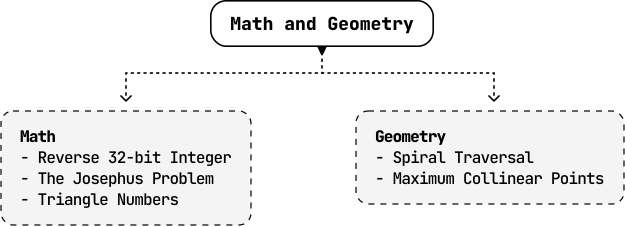
Image represents a hierarchical diagram illustrating categories within 'Math and Geometry.'  A rounded rectangle at the top, labeled 'Math and Geometry,' acts as the root node.  From this root, a dashed horizontal line extends, branching into two subordinate, rounded-rectangle boxes. The left box is labeled 'Math' and lists three sub-items: 'Reverse 32-bit Integer,' 'The Josephus Problem,' and 'Triangle Numbers.' The right box is labeled 'Geometry' and contains two sub-items: 'Spiral Traversal' and 'Maximum Collinear Points.'  All text within the boxes is in a monospace font.  The dashed lines indicate a hierarchical relationship, showing that 'Math' and 'Geometry' are subcategories of 'Math and Geometry,' and the listed items are specific problems or concepts within those subcategories.