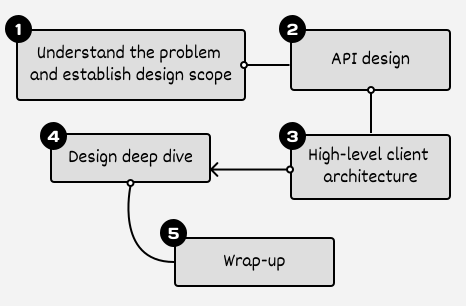
Having a clear framework for Mobile System Design (MSD) interviews is more important than many realize. Without a clear structure, the interview can feel disorganized and challenging for both you and the interviewer. Unlike coding interviews with defined solutions, system design challenges invite multiple valid approaches, making a methodical strategy essential.
Below, we briefly outline a 5-step framework to give you a high-level understanding. Detailed explanations and practical applications of each step are explored through case studies in later chapters.
MSD interviews typically start with broad questions such as "Design a News Feed app" or "Design a Pagination library." While these questions may seem straightforward, understanding exactly what you need to design is a crucial part of the interview.
Your first task is to clarify what's in and out of scope by asking targeted questions to define the boundaries of your design. The interviewer's answers will guide your technology choices and help you make informed trade-offs. This initial scoping sets the foundation for your solution, making each interview unique.
What kind of questions should you ask? Here's a list of different types of questions to help you get started:
What are we building? These help uncover both functional and non-functional requirements, as well as what is out of scope for the interview. For example, you could ask:
For whom are we building? These help understand the scale, usage patterns, and how performant the solution should be. For example, you could ask:
What are the system's constraints? These clarify the system boundaries and technology choices. For example, you could ask:
While gathering requirements, you may find that some answers reveal information about other aspects of the system. Feel free to make reasonable assumptions based on these responses, just be sure to state them clearly so your interviewer can correct any misunderstandings.
The goal isn't to ask every possible question. Instead, focus your questions on what's most relevant for the specific problem at hand, using your judgment to determine which details are most important to clarify.
📌 Remember: Your interviewer's answers to these questions will guide your technical decisions and trade-offs throughout the design process. Make sure to reference back to these requirements when explaining your choices later in the interview.
The API design step is where you establish the contract between our client apps and external dependencies. This step is crucial because it helps align your understanding with the interviewer's expectations and creates a solid foundation for the rest of your design.
When designing an app that needs to communicate with a backend, start by defining the appropriate communication protocols for your specific use cases and the endpoints involved. On the other hand, if you're designing a mobile library, focus on outlining its public APIs, including how host apps will initialize, configure, and interact with your library.
As you define the API, outline the data models that will power these interactions. Whether you're working with JSON payloads, Swift structs, Kotlin data classes, or even protocol buffers for efficiency, these models need to capture the data's structure and relationships clearly.
After finishing the API design, it's time to create a high-level client architecture diagram that shows how these components work together.
This high-level diagram sets the stage for the design and shows exactly which components you need to fulfill our requirements. Most importantly, it helps you validate that you have a complete end-to-end flow that meets all the functionality our system needs. As you create the diagram, you should also identify interesting points that warrant deeper discussion in the deep dive step later.
In this step, work with your interviewer to identify bottlenecks and explore specific components in greater detail. Generally, you should aim for two to three strong deep-dive discussions, though this isn't a strict rule and can vary depending on the situation.
You should continue refining your client architecture during this step. Make sure to update your diagrams to reflect any new decisions or components you introduce.
Pay attention to your interviewer's reactions and questions. If they express interest in multiple topics, manage your time carefully to give each topic the attention it deserves while staying within the interview's time constraints.
If time allows, the final phase of your interview provides an opportunity to demonstrate your ability to think critically about your design and consider future improvements. Here's how to wrap up effectively:
Time management is key in MSD interviews. With only 45-60 minutes to work with and a lot of ground to cover, having a solid plan helps you stay on track. Here's how to break down a typical 45-minute interview:
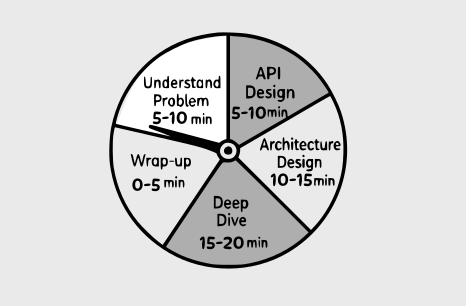
Remember that these are guidelines rather than strict rules. Be ready to adjust based on the specific problem and your interviewer's interests. The key is maintaining enough flexibility to explore important areas while ensuring you complete the full design within the time limit.