There is a chessboard of size n x n. Your goal is to place n queens on the board such that no two queens attack each other. Return the number of distinct configurations where this is possible.
Example:
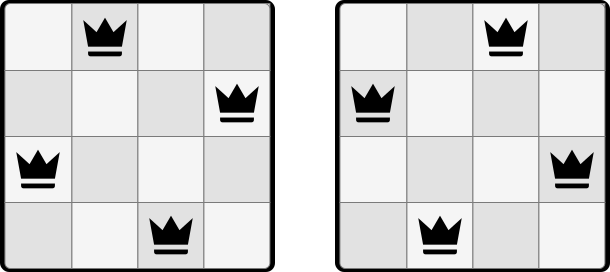
Input: n = 4
Output: 2
There is a chessboard of size n x n. Your goal is to place n queens on the board such that no two queens attack each other. Return the number of distinct configurations where this is possible.
Input: n = 4
Output: 2
New to this one? Start here. Below is the core idea in everyday language, plus a real-world analogy—then the sections that follow build on it with the formal reasoning, code, and step-by-step walkthroughs.
Imagine n guests who all dislike each other and refuse to sit in the same row, the same column, or on the same diagonal of a grid of tables. You seat them one row at a time. If a row has no safe seat left, you know an earlier choice was bad, so you go back and move the previous guest. That “go back and move the previous one” is backtracking.
Place exactly one queen per row and move down row by row. That instantly removes all row conflicts, so we only ever check columns and the two diagonals. A square (r, c) sits on diagonal r − c and anti-diagonal r + c — two numbers we can track cheaply.
Queens can move vertically, horizontally, and diagonally:
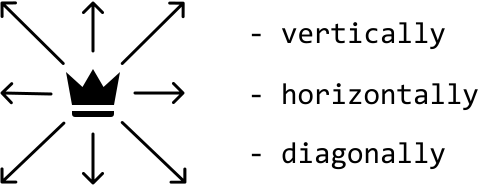
So, it's only possible to place a queen on a square of the board when:
Based on this, let’s identify a method for placing the queens.
Placing the queens - backtracking
A straightforward strategy is to place one queen on the board at a time, making sure each new queen is placed on a safe square where it can’t be attacked. If we can no longer safely place a queen, it means one or more of the previously placed queens need to be repositioned. In this case, we backtrack by changing the position of the previous queen and trying again.
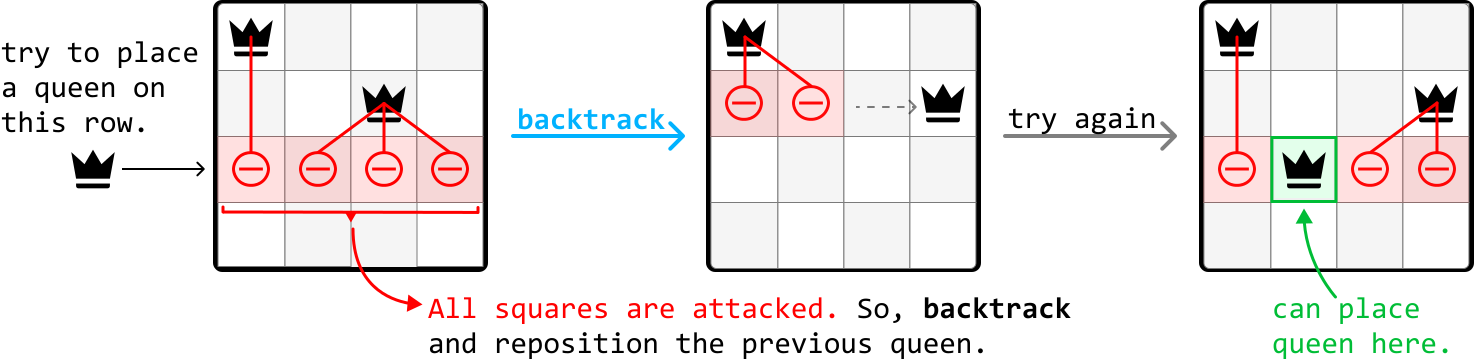
To make backtracking more efficient, we can place each queen on a new row. This way, we don’t have to worry about conflicts between queens on the same row, and only need to check for an opposing queen on the same column and along the diagonals of the square where the new queen is placed. If a queen cannot be placed anywhere on this new row, we backtrack, reposition the previous row’s queen, and then try again:
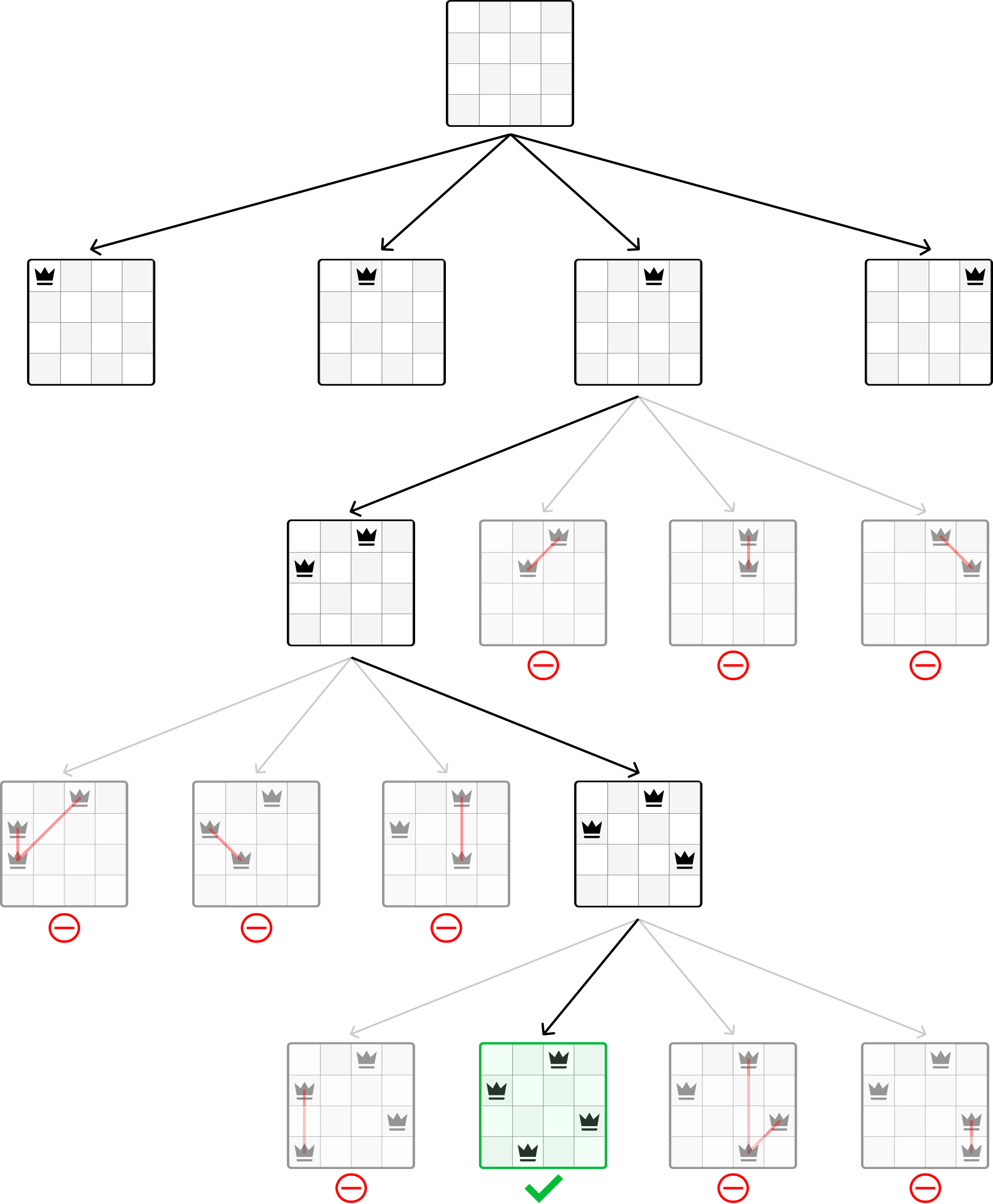
A partial state space tree for this backtracking process is visualized below for n = 4:
We’re still left with some questions. In particular, how can we tell if a square is being attacked, and how exactly do we “place” or “remove” a queen?
Detecting opposing queens
One challenge in this problem is determining if a square is attacked by another queen. We could do a linear search across the row, column, and diagonals every time we want to place a new queen, but this is quite inefficient. A key observation is that we don't necessarily need to know the exact positions of all the queens. We only need to know if there exists a queen in any given square's row, column, or diagonals. We can use hash sets to efficiently check for this.
Note that we don’t need a hash set for rows because we always place each queen on a different row. For columns, whenever we place a new queen on a square (r, c), we can add that square’s column id (c) to a column hash set.
What about diagonals? How can we determine which diagonal we're on? Since there are two types of diagonals, let’s refer to the diagonal that goes from top-left to bottom-right as the "diagonal", and the one that goes from top-right to bottom-left as the "anti-diagonal". Consider the following diagrams:
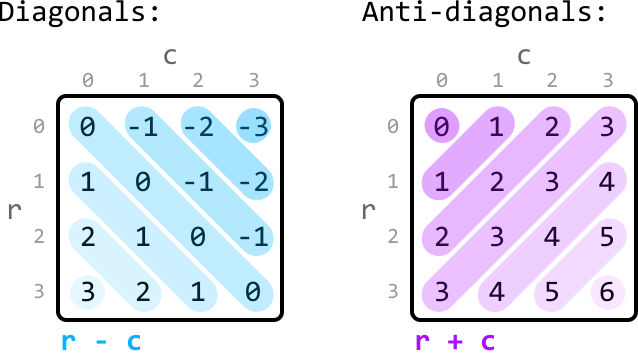
The key observation here is that, for any square (r, c), its diagonal can be identified using the id r - c, and its anti-diagonal is identified using the id r + c. Similarly to how we keep track of column ids, we can use a diagonal and an anti-diagonal hash set to keep track of diagonal and anti-diagonal ids, respectively.
Placing and removing a queen
Now that we have a way to identify opposing queens, we know the action of "placing" a queen means adding its column, diagonal, and anti-diagonal ids to their respective hash sets. Inversely, to remove a queen, we just remove those exact ids from the hash sets.
Note, this implementation uses a global variable as it leads to a more readable solution. However, it's important to confirm with your interviewer whether global variables are acceptable.
from typing import Set

res = 0

def n_queens(n: int) -> int:
   dfs(0, set(), set(), set(), n)
   return res

def dfs(r: int, diagonals_set: Set[int], anti_diagonals_set: Set[int], cols_set: Set[int], n: int) -> None:
    global res
    # Termination condition: If we have reached the end of the rows, we've placed all
    # 'n' queens.
    if r == n:
        res += 1
        return
    for c in range(n):
        curr_diagonal = r - c
        curr_anti_diagonal = r + c
        # If there are queens on the current column, diagonal or anti-diagonal, skip
        # this square.
        if (c in cols_set or curr_diagonal in diagonals_set or curr_anti_diagonal in anti_diagonals_set):
            continue
        # Place the queen by marking the current column, diagonal, and anti-diagonal
        # as occupied.
        cols_set.add(c)
        diagonals_set.add(curr_diagonal)
        anti_diagonals_set.add(curr_anti_diagonal)
        # Recursively move to the next row to continue placing queens.
        dfs(r + 1, diagonals_set, anti_diagonals_set, cols_set, n)
        # Backtrack by removing the current column, diagonal, and anti-diagonal from
        # the hash sets.
        cols_set.remove(c)
        diagonals_set.remove(curr_diagonal)
        anti_diagonals_set.remove(curr_anti_diagonal)
#include <vector>
#include <unordered_set>
using namespace std;
int solve(int row, int n, unordered_set<int>& cols,
unordered_set<int>& diag, unordered_set<int>& anti) {
if (row == n) { // placed all n queens
return 1;
}
int count = 0;
for (int col = 0; col < n; col++) {
int d = row - col; // diagonal id
int a = row + col; // anti-diagonal id
if (cols.count(col) || diag.count(d) || anti.count(a)) {
continue; // square is attacked -> skip
}
cols.insert(col); diag.insert(d); anti.insert(a); // place
count += solve(row + 1, n, cols, diag, anti);
cols.erase(col); diag.erase(d); anti.erase(a); // undo
}
return count;
}
int nQueens(int n) {
unordered_set<int> cols, diag, anti;
return solve(0, n, cols, diag, anti);
}// These methods live inside a class, e.g. class Solution { ... }
int nQueens(int n) {
Set<Integer> cols = new HashSet<>();
Set<Integer> diag = new HashSet<>();
Set<Integer> anti = new HashSet<>();
return solve(0, n, cols, diag, anti);
}
int solve(int row, int n, Set<Integer> cols, Set<Integer> diag, Set<Integer> anti) {
if (row == n) { // placed all n queens
return 1;
}
int count = 0;
for (int col = 0; col < n; col++) {
int d = row - col; // diagonal id
int a = row + col; // anti-diagonal id
if (cols.contains(col) || diag.contains(d) || anti.contains(a)) {
continue; // square is attacked -> skip
}
cols.add(col); diag.add(d); anti.add(a); // place
count += solve(row + 1, n, cols, diag, anti);
cols.remove(col); diag.remove(d); anti.remove(a); // undo
}
return count;
}Time complexity: The time complexity of n_queens is . Here’s why:
Space complexity: The space complexity is because the maximum depth of the recursion tree is . The hash sets also contribute to this space complexity because they each store up to values.
Two step-by-step walkthroughs of the algorithm below: a valid case (the expected happy path) and an invalid / edge case that exercises the tricky parts. Each step shows the program state as the code runs—the same steps apply to Python, C++ and Java.
We go row by row. Row 0 tries column 0 first; it leads to a dead end, so we backtrack and try column 1, which works out.
| row | tries | result |
|---|---|---|
| 0 | col 0 | place (0,0) |
| 1 | col 0,1 attacked; col 2 | place (1,2) |
| 2 | 0,1,2,3 all attacked | dead end → backtrack |
| 0 | col 1 | place (0,1) |
| 1–3 | (1,3),(2,0),(3,2) | all safe → solution, count = 1 |
Continuing the search (starting row 0 at columns 2 and 3) finds exactly one more board → total 2. ✓
A 3×3 board is too cramped: three mutually non-attacking queens cannot fit. Every starting column dies.
| start | outcome | solutions |
|---|---|---|
| (0,0) | row 2 has no safe square | 0 |
| (0,1) | row 1 fully attacked | 0 |
| (0,2) | row 2 has no safe square | 0 |
| total | no board possible | 0 |
Only n = 1 and n ≥ 4 have solutions; n = 2 and n = 3 return 0. ✗
Sets use in / add / remove. We return a running count up the recursion instead of a global, which keeps the function pure.
unordered_set<int> with .count() (0 or 1) / .insert() / .erase(). The diagonal ids r−c can be negative — that is fine for a hash set.
Set<Integer> with contains / add / remove. Autoboxing turns the int ids into Integer keys automatically.