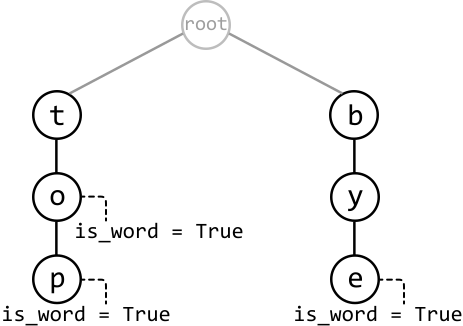
Design and implement a trie data structure that supports the following operations:
insert(word: str) -> None: Inserts a word into the trie.search(word: str) -> bool: Returns true if a word exists in the trie, and false if not.has_prefix(prefix: str) -> bool: Returns true if the trie contains a word with the given prefix, and false if not.Input: [
insert('top'),
insert('bye'),
has_prefix('to'),
search('to'),
insert('to'),
search('to')
]
Output: [True, False, True]
Explanation:
insert("top")    # trie has: "top"
insert("bye")    # trie has: "top" and "bye"
has_prefix("to") # prefix "to" exists in the string "top": return True
search("to")     # trie does not contain the word "to": return False
insert("to")     # trie has: "top", "bye", and "to"
search("to")     # trie contains the word "to": return True
The words and prefixes consist only of lowercase English letters.
The length of each word and prefix is at least one character.
New to this one? Start here. Below is the core idea in everyday language, plus a real-world analogy—then the sections that follow build on it with the formal reasoning, code, and step-by-step walkthroughs.
Think of words as rooms and letters as doors in a hallway. apple and apply walk down the same hallway a→p→p→l, then split at the last door. We never rebuild the shared hallway — we reuse it. startsWith just asks “can I walk this far down the hallway?” while search also asks “and is there a real room right here?”
Let’s define a TrieNode using the same definition introduced in the introduction. In this implementation, the is_word attribute will be used to indicate whether a TrieNode marks the end of a word.
Initializing the trie
To initialize the Trie, we define the root TrieNode in the constructor. All words inserted into the trie will branch out from this root node.
Inserting a word into the trie
The insert function builds the trie word by word. What makes a trie useful is that it reduces redundancy by reusing existing nodes when possible. For example, if we insert “byte” when “bye” already exists in the trie, these two words should share the nodes that make up the prefix “by” to save space. This is an important point that will shape our implementation of this function.
To understand the insertion logic, let's walk through an example. Consider inserting the word "byte" into the trie below.
We first check if 'b', the first letter of the string, exists as a child of the root node by querying the hash map containing its children. In this case, it does. So, move to node 'b':
![Image represents a Trie data structure illustrating the insertion of the word 'byte'. The diagram shows a root node labeled 'root' (light gray) connected to two child nodes: 't' (black) and 'b' (orange). The 't' node branches down to 'o' and then 'p', each labeled with 'is_word = True', indicating these letter combinations are valid words. The 'b' node connects to 'y' and then 'e', also labeled 'is_word = True'. A dashed box to the right explains the insertion process: ' 'b' is a child of the current node' and the code snippet `node = node.children['b']` shows how the current node is updated to point to the 'b' node during insertion. A rectangular box labeled 'node' points to the root node initially, indicating the starting point of the insertion process. The lines connecting the nodes represent parent-child relationships within the Trie.](images/img-97bb6a96cd3d.svg)
Now consider the second letter, ‘y’. Similarly, node 'y' exists as a child of node 'b', so let's move to node 'y':
![Image represents a tree-like data structure illustrating a coding pattern. The topmost node, labeled 'root' in light gray, branches into two nodes: 't' and 'b'. The 't' node connects downwards to 'o', which further connects to 'p'. Dashed lines connect 'o' and 'p' to the text 'is_word = True', indicating a property associated with these nodes. Similarly, the 'b' node connects to a node 'y' highlighted in orange, which then connects to 'e'. 'e' also has a dashed line connecting it to 'is_word = True'. A rectangular box to the right shows the code snippet `'y' is a child of the current node => node = node.children['y']`, explaining how to access the child node 'y' from a parent node (represented by the variable 'node'). A smaller rectangular box labeled 'node' points to the 'b' node, illustrating the current node in the example. The overall structure depicts a Trie or prefix tree, commonly used in data structures and algorithms, particularly for efficient string searching.](images/img-f4ff6697a03f.svg)
Now consider the next letter, ‘t’. Since node 't' doesn't exist as a child of node 'y', we need to create it and add it to node 'y’s children hash map. Then, we can move to this newly created node 't':
![Image represents a Trie data structure visualization alongside code snippets illustrating its modification. The Trie is depicted as a tree with a light-grey root node labeled 'root'. Two branches extend from the root, leading to nodes labeled 't' and 'b' respectively. The 't' node connects to an 'o' node, which in turn connects to a 'p' node. Both 'o' and 'p' nodes have dashed lines indicating a boolean attribute 'is_word = True'. The 'b' node connects to a 'y' node, which further connects to an 'e' node. The 'e' node also has a dashed line indicating 'is_word = True'. A dashed line connects the 'y' node to a new, orange-colored 't' node, representing a node being added. A rectangular box to the right displays code comments explaining that 't' is not a child of the current node ('y'), followed by two lines of code: `node.children['t'] = TrieNode()` which creates a new TrieNode for 't', and `node = node.children['t']` which updates the current node pointer to the newly created 't' node. A separate rectangular box labeled 'node' points to the 'y' node, indicating the current node before the addition of the 't' node.](images/img-3e59d0a0e578.svg)
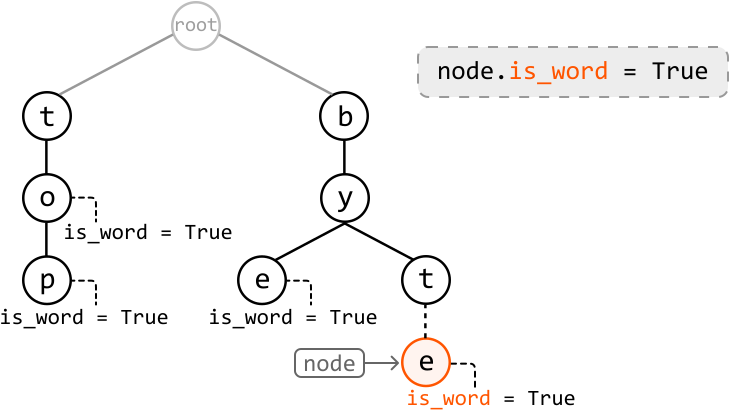
The last letter is ‘e’, which doesn’t exist as a child of node ‘t’. So, let’s create node ‘e’ and add it to node ‘t’s children:
![Image represents a Trie data structure illustrating the insertion of a new node. The Trie is visualized as a tree with a light gray root node labeled 'root'. From the root, two branches extend to nodes labeled 't' and 'b'. The 't' node connects to an 'o' node, which in turn connects to a 'p' node. Both 'o' and 'p' nodes have a dashed line and label 'is_word = True', indicating they represent complete words. The 'b' node connects to a 'y' node, which further branches to 'e' and 't' nodes. The 'e' node has 'is_word = True'. A dashed line connects the 't' node to a new, orange-colored 'e' node, labeled 'node', signifying the addition of this node. A separate box explains the process: ''e' is not a child of the current node' followed by two lines of code: '→ node.children['e'] = TrieNode()' and '→ <font color='orange'>node</font> = node.children['e']', showing how a new TrieNode is created and assigned to the 'e' child of the current node. The arrows indicate the flow of information and the creation of a new node within the Trie.](images/img-ffeac37ba12e.svg)
Now that we've reached the end of the word, we should set the is_word attribute of node 'e' to true, indicating that it marks the end of a word.
Searching for a word
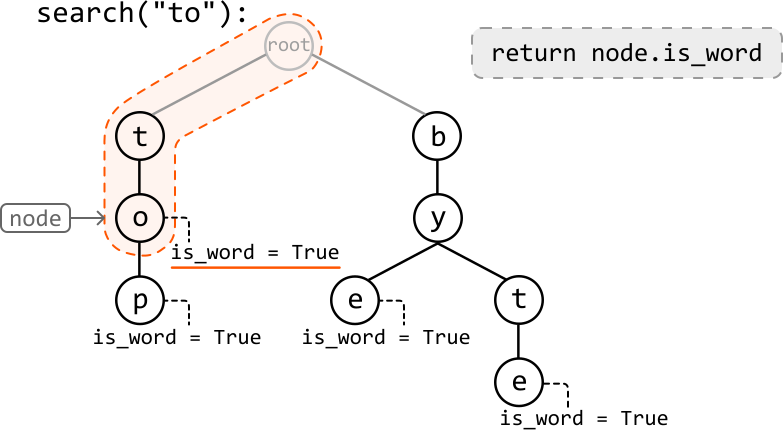
Searching for a word involves the same strategy as insertion, where we move node by node down the trie. The two main differences are:
If a node corresponding to the current character in the word isn't found at any point, we return false because this would indicate the word doesn't exist in the trie.
After traversing all characters of the search term, we return true only if the final node's is_word attribute is true.
Searching for a prefix
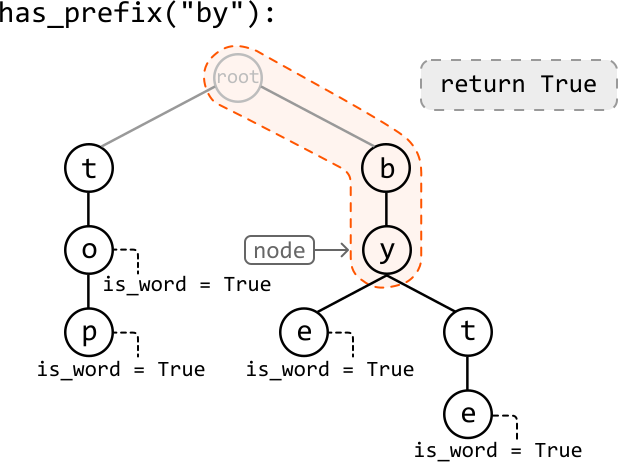
The logic for finding a prefix is nearly identical to the logic discussed above for the search function. The only difference is after successfully traversing all characters in our search term, we can just return true without checking the final node's is_word attribute, as a prefix doesn’t need to end at the end of a word.
class TrieNode:
    def __init__(self):
        self.children = {}
self.is_word = Falseclass Trie:
def __init__(self):
self.root = TrieNode()
def insert(self, word: str) -> None:
node = self.root
for c in word:
# For each character in the word, if it’s not a child of the current node,
# create a new TrieNode for that character.
if c not in node.children:
node.children[c] = TrieNode()
node = node.children[c]
# Mark the last node as the end of a word.
node.is_word = True
def search(self, word: str) -> bool:
node = self.root
for c in word:
# For each character in the word, if it’s not a child of the current node,
# the word doesn't exist in the Trie.
if c not in node.children:
return False
node = node.children[c]
# Return whether the current node is marked as the end of the word.
return node.is_word
def has_prefix(self, prefix: str) -> bool:
node = self.root
for c in prefix:
if c not in node.children:
return False
node = node.children[c]
# Once we’ve traversed the nodes corresponding to each character in the
# prefix, return True.
return Truestruct TrieNode {
map<char, TrieNode*> children;
bool isWord = false;
};
struct Trie {
TrieNode* root = new TrieNode();
void insert(const string& word) {
TrieNode* node = root;
for (char ch : word) {
if (node->children.count(ch) == 0) { // letter not present yet
node->children[ch] = new TrieNode();
}
node = node->children[ch];
}
node->isWord = true;
}
TrieNode* find(const string& s) { // shared walk
TrieNode* node = root;
for (char ch : s) {
if (node->children.count(ch) == 0) {
return nullptr; // fell off the tree
}
node = node->children[ch];
}
return node;
}
bool search(const string& word) {
TrieNode* node = find(word);
if (node == nullptr) {
return false;
}
return node->isWord; // landed AND flagged
}
bool startsWith(const string& prefix) {
TrieNode* node = find(prefix);
return node != nullptr; // just need to land
}
};class TrieNode {
Map<Character, TrieNode> children = new HashMap<>();
boolean isWord = false;
}
class Trie {
TrieNode root = new TrieNode();
void insert(String word) {
TrieNode node = root;
for (char ch : word.toCharArray()) {
node.children.putIfAbsent(ch, new TrieNode());
node = node.children.get(ch);
}
node.isWord = true;
}
TrieNode find(String s) { // shared walk
TrieNode node = root;
for (char ch : s.toCharArray()) {
if (!node.children.containsKey(ch)) return null;
node = node.children.get(ch);
}
return node;
}
boolean search(String word) { TrieNode n = find(word); return n != null && n.isWord; }
boolean startsWith(String prefix) { return find(prefix) != null; }
}Time complexity:
insert is , where is the length of the word being inserted. This is because we traverse through or insert up to nodes into the trie in each iteration.search and has_prefix is because we search through at most characters in the trie.Space complexity:
insert is because in the worst case, the inserted word doesn’t share any prefix with words already in the trie. In this case, new nodes are created.search and has_prefix is because no additional space is used to traverse the search term in the trie.Two step-by-step walkthroughs of the algorithm below: a valid case (the expected happy path) and an invalid / edge case that exercises the tricky parts. Each step shows the program state as the code runs—the same steps apply to Python, C++ and Java.
search("apple") walks all five letters, lands on the e node, and that node’s flag is set.
| step | letter | child exists? | node after step |
|---|---|---|---|
| 1 | a | yes | a |
| 2 | p | yes | a→p |
| 3 | p | yes | a→p→p (is_word) |
| 4 | l | yes | …→l |
| 5 | e | yes | …→e, is_word = True → true |
Now startsWith("app"): walk a→p→p, all links exist, so we landed — return true (we never look at the flag). ✓
Case A — a real prefix that is not a word. search("appl") walks a→p→p→l successfully and lands on the l node — but that node’s is_word is False (nobody inserted appl). So search returns false, even though startsWith("appl") would return true. This is exactly why the flag exists.
| step | letter | result |
|---|---|---|
| 1–4 | a, p, p, l | all links exist — land on node l |
| end | — | l.is_word == False → false |
Case B — the walk falls off. search("apricot"): after a→p we are on the first p node, whose only child is another p. The next letter is r — no such link.
| step | letter | child exists? |
|---|---|---|
| 1 | a | yes |
| 2 | p | yes |
| 3 | r | no → _find returns None → false |
Two different roads to false: flag not set (Case A) vs. fell off the tree (Case B). The helper handles both cleanly. ✓
A plain dict is the child map and ch not in node.children tests a missing link. Returning None from _find gives the clean node is not None and node.is_word check.
We use map<char, TrieNode*> and .count(ch) to test membership (unordered_map works too and is O(1) average). Nodes are heap-allocated with new; a production version would free them or use smart pointers.
putIfAbsent creates the child only when missing, and containsKey tests the link. Note char autoboxes to Character as the map key — harmless here.