You are given an array representing the heights of trees, and an integer k representing the total length of wood that needs to be cut.
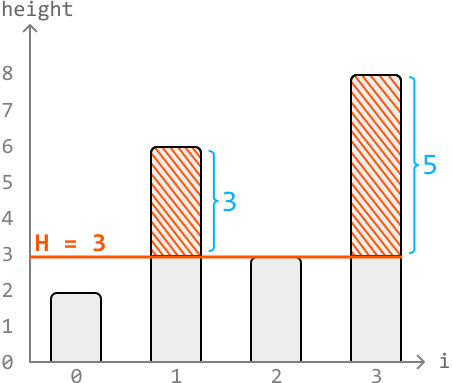
For this task, a woodcutting machine is set to a certain height, H. The machine cuts off the top part of all trees taller than H, while trees shorter than H remain untouched. Determine the highest possible setting of the woodcutter (H) so that it cuts at least k meters of wood.
Assume the woodcutter cannot be set higher than the height of the tallest tree in the array.
Example:
Input: heights = [2, 6, 3, 8], k = 7
Output: 3
Explanation: The highest possible height setting that yields at least k = 7 meters of wood is 3, which yields 8 meters of wood. Any height setting higher than this will yield less than 7 meters of wood.
Constraints:
It's always possible to attain at least k meters of wood.
There's at least one tree.
In Plain English
New to this one? Start here. Below is the core idea in everyday language, plus a real-world analogy—then the sections that follow build on it with the formal reasoning, code, and step-by-step walkthroughs.
🌱 A real-world picture: a lawnmower's cutting height
Raise the mower blade and you cut less grass; lower it and you cut more. You want the highest setting that still fills your bag. Notice the one-way trend: the higher the blade, the less you collect — never the other way around. That “only goes one direction” property is exactly what lets binary search work here.
Intuition
At first, it might strike you as strange that this problem is in the Binary Search chapter. The given input array isn't necessarily sorted, so how is binary search applicable here? Well, this is an example of a common application of binary search, where the search space does not encompass the input array.
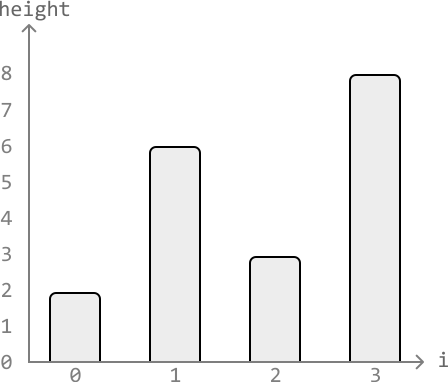
Let’s consider a visualization of four trees of heights [2, 6, 3, 8] and assume k = 7:
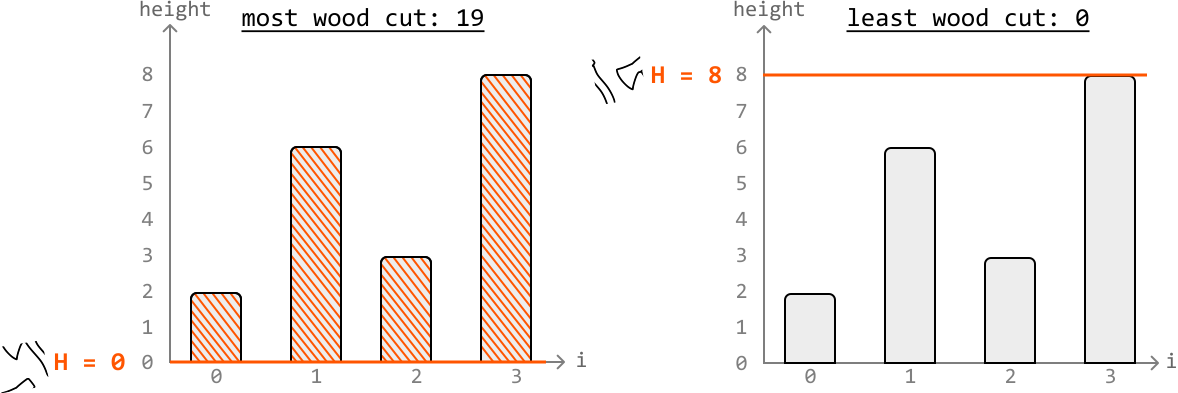
The tallest tree above has a height of 8. So the height setting, H, can be set to any height between 0 and 8.
The most amount of wood is cut at H = 0, where all trees are cut from the bottom.
The least amount of wood is cut at H = 8, where no wood is cut at all.
Gradually increasing the height setting of the woodcutter from H = 0 to H = 8 yields less and less wood, and our goal is to find the highest value of H that gives us at least k meters of wood.
Determining if a height setting yields enough wood
We need a function that determines if any given height setting H yields at least k meters of wood.
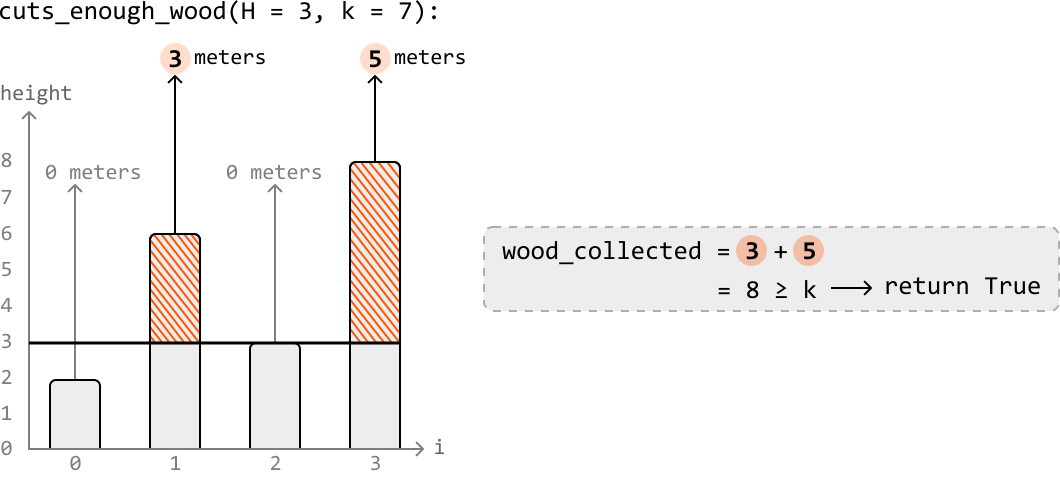
Let’s name this function cuts_enough_wood(H, k), which will calculate the total wood obtained by cutting the trees taller than H, and return true if this total meets or exceeds k. Below is a visual representation of how to determine if a height setting of 3 yields enough wood in the example:
Applying this function to all possible values of H (from 0 to 8) gives us the outcome below, where heights 0 to 3 yield at least k meters of wood and heights 4 to 8 are too high and don’t yield enough. Note that here, we visualize which H values make the function cuts_enough_wood return true, and which will result in false.
We could call cuts_enough_wood on each value of H from 0 to 8 until we reach the highest value that still causes cuts_enough_wood to return true. However, a key observation is that the above sequence of boolean outcomes is effectively a sorted sequence, since all true outcomes are positioned before false ones.
As this is a sorted sequence, we should try using binary search.
Binary search
The goal is to find the last value of H that cuts at least k meters of wood. In other words, we’re looking for the upper bound value of H that satisfies this condition.
As such, we should use upper-bound binary search. This means we’ll need to calculate
the midpoint using mid = (left + right) // 2 + 1, as mentioned in the First
and Last Occurrences of a Number problem.
Let’s first define the search space. Our search space should encompass all values of H between 0 and the height of the tallest tree in the array, as these are all possible answers.
To figure out how to narrow the search space, let's use the example below, setting left and right pointers at the ends of the search space:
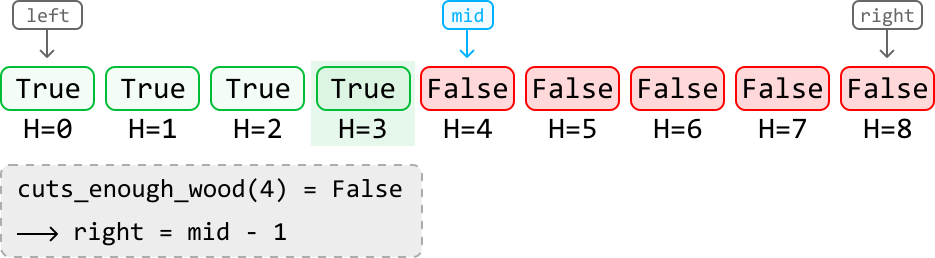
Initially, the midpoint is set to H = 4. When we call cuts_enough_wood(4, k), it returns false. This means the height setting is not yielding enough wood and is, hence, set too high. To find a lower height setting, we should narrow our search space toward the left:
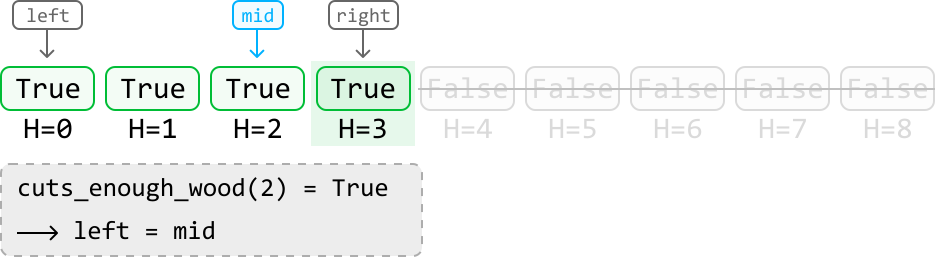
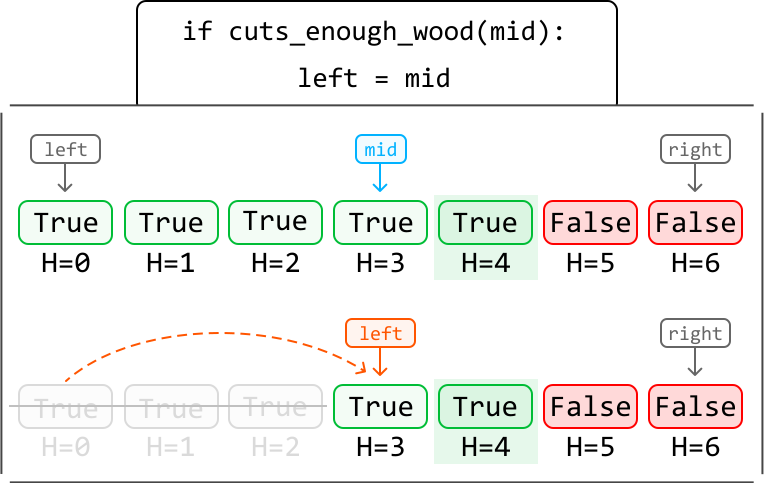
The next midpoint is set to H = 2. When we call cuts_enough_wood(2, k), it returns true. This means the upper bound is either at the midpoint or to its right, as the upper bound is the rightmost height setting that cuts enough wood.
So, narrow the search space toward the right while including the midpoint:
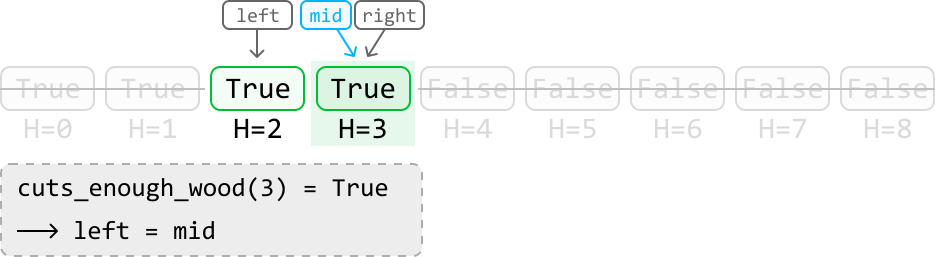
The next midpoint is set to H = 3. When we call cuts_enough_wood(3, k), it returns true. So, narrow the search space toward the right while including the midpoint:
Once the left and right pointers meet, we have located the upper bound height setting that yields at least k meters of wood.
Summary
Case 1: The midpoint is set at a height that allows us to cut at least k meters of wood, indicating the upper bound is somewhere to the right. Narrow the search space to the right while including the midpoint:
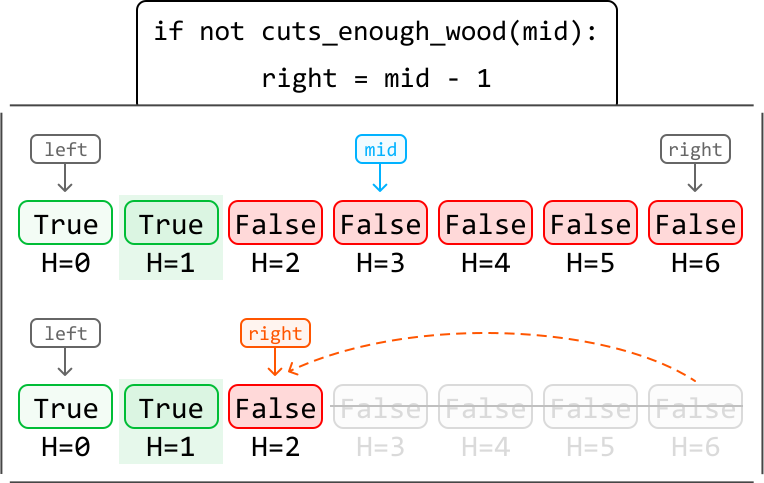
Case 2: The midpoint is at a height that doesn’t allow us to cut enough wood, indicating the upper bound is somewhere to the left. Narrow the search space to the left while excluding the midpoint:
Implementation
from typing import List

def cutting_wood(heights: List[int], k: int) -> int:
    left, right = 0, max(heights)
    while left < right:
        # Bias the midpoint to the right during the upper-bound binary search.
        mid = (left + right) // 2 + 1
        if cuts_enough_wood(mid, k, heights):
            left = mid
        else:
            right = mid - 1
    return right

# Determine if the current value of 'H' cuts at least 'k' meters of wood.
def cuts_enough_wood(H: int, k: int, heights: List[int]) -> bool:
    wood_collected = 0
    for height in heights:
        if height > H:
            wood_collected += (height - H)
    return wood_collected >= k
int cuttingWood(vector<int>& heights, long long k) {
    auto woodCollected = [&](int H) {          // total wood above blade H
        long long total = 0;
        for (int h : heights) {
            if (h > H) {
                total += (long long)(h - H);
            }
        }
        return total;
    };
    int maxH = 0;
    for (int h : heights) {
        maxH = max(maxH, h);
    }
    int left = 0, right = maxH, best = 0;
    while (left <= right) {
        int mid = left + (right - left) / 2;
        if (woodCollected(mid) >= k) {          // enough -> try higher blade
            best = mid;
            left = mid + 1;
        } else {                                // not enough -> lower blade
            right = mid - 1;
        }
    }
    return best;
}
public int cuttingWood(int[] heights, long k) {
    int maxH = 0;
    for (int h : heights) maxH = Math.max(maxH, h);
    int left = 0, right = maxH, best = 0;
    while (left <= right) {
        int mid = left + (right - left) / 2;
        if (woodCollected(heights, mid) >= k) {  // enough -> try higher blade
            best = mid;
            left = mid + 1;
        } else {                                  // not enough -> lower blade
            right = mid - 1;
        }
    }
    return best;
}

private long woodCollected(int[] heights, int H) {   // total wood above blade H
    long total = 0;
    for (int h : heights) if (h > H) total += (long)(h - H);
    return total;
}
Complexity Analysis
Time complexity: The time complexity of cutting_wood is O(nlog(m)), where m is the maximum height of the trees. This is because we perform a binary search over the range [0, m]. Each iteration of the binary search calls the cuts_enough_wood function, which runs in O(n) time, where n is the number of trees. This results in an overall time complexity of O(log(m))O(n)=O(nlog(m)).
Space complexity: The space complexity is O(1).
Dry Runs
Two step-by-step walkthroughs of the algorithm below: a valid case (the expected happy path) and an invalid / edge case that exercises the tricky parts. Each step shows the program state as the code runs—the same steps apply to Python, C++ and Java.
✅ Dry run 1 (valid) — k = 14. Highest feasible blade should be H = 4 (collects 17).
blade at H = 4
4
9
5
12
7
kept (below blade) collected (above blade) blade line
At H = 4 we collect (9−4) + (5−4) + (12−4) + (7−4) = 5 + 1 + 8 + 3 = 17 ≥ 14. Raise it one notch to H = 5 and you'd get only 4 + 0 + 7 + 2 = 13 < 14 — so H = 4 is the highest that still works.
The binary search, step by step
Feasible (≥ 14) → record best and go higher; infeasible → go lower.
left
right
mid
wood(mid)
≥ 14?
action
0
12
6
10
no
too high → right = 5
0
5
2
27
yes
best = 2, go higher → left = 3
3
5
4
17
yes
best = 4, go higher → left = 5
5
5
5
13
no
too high → right = 4
5
4
—
—
—
left > right → return best = 4
❌ Dry run 2 (invalid) — k = 100. The whole forest is only 37 units of wood, so no blade works → return 0.
blade at H = 0
4
9
5
12
7
Even a ground-level blade (H = 0) collects every unit: 4 + 9 + 5 + 12 + 7 = 37. That's the maximum possible, and 37 < 100, so the goal is impossible — best never leaves its starting value of 0.
The binary search, step by step
Every blade is infeasible, so best stays 0 while the window collapses.
left
right
mid
wood(mid)
≥ 100?
action
0
12
6
10
no
right = 5
0
5
2
27
no
right = 1
0
1
0
37
no
right = -1
0
-1
—
—
—
left > right → return best = 0
Returning 0 is the honest “can't do it” answer: a blade at height 0 cuts nothing off any tree above it and simply signals no feasible height was found.
The same logic in each language
The left/right/mid steps match the tables above. Python-specific: integers never overflow, so the running wood total is safe as a plain int.
Same steps. C++-specific: sum the wood into a long long (and k is long long) so tall forests don't overflow.
Same steps. Java-specific: sum into a long, and find maxH with a Math.max scan.