Given a singly linked list, determine if it contains a cycle. A cycle occurs if a node's next pointer references an earlier node in the linked list, causing a loop.
Example:
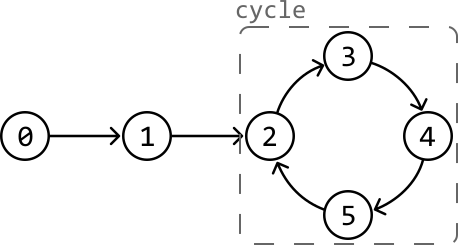
Output: True
Given a singly linked list, determine if it contains a cycle. A cycle occurs if a node's next pointer references an earlier node in the linked list, causing a loop.
Output: True
New to this one? Start here. Below is the core idea in everyday language, plus a real-world analogy—then the sections that follow build on it with the formal reasoning, code, and step-by-step walkthroughs.
Two runners set off together, one twice as fast. If the course is a straight road, the fast runner reaches the end and leaves. If the course is a loop, there is no end — the fast runner keeps going around and will eventually come up behind the slow runner and tap them on the shoulder. A tap on the shoulder means “this track is a circle.”
A straightforward approach is to iterate through the linked list while keeping track of the nodes that were already visited in a hash set. Encountering a previously-visited node during the traversal indicates the presence of a cycle. Below is the code snippet for this approach:
from ds import ListNode

def linked_list_loop_naive(head: ListNode) -> bool:
    visited = set()
    curr = head
    while curr:
        # Cycle detected if the current node has already been visited.
        if curr in visited:
            return True
        visited.add(curr)
        curr = curr.next
    return False
#include <unordered_set>
using namespace std;
bool linkedListLoopNaive(ListNode* head) {
unordered_set<ListNode*> seen;
for (ListNode* node = head; node != nullptr; node = node->next) {
if (seen.count(node)) return true; // seen before -> cycle
seen.insert(node); // store the pointer (identity)
}
return false; // reached the end -> no cycle
}public boolean linkedListLoopNaive(ListNode head) {
java.util.Set<ListNode> seen = new java.util.HashSet<>();
for (ListNode node = head; node != null; node = node.next) {
if (seen.contains(node)) return true; // seen before -> cycle
seen.add(node); // default equals is identity
}
return false; // reached the end -> no cycle
}This solution takes time, where is the number of nodes in the linked list, since each node is visited once. However, this comes at the cost of extra space due to the hash set. Is there a way to achieve a linear time complexity while using constant space?
Imagine a race track represented as a circular linked list (i.e., a linked list with a perfect cycle) where two runners start at the same node.
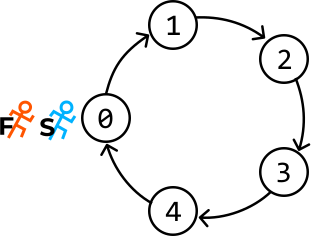
If both runners move at the same speed, they will always be together at each node. However, consider what happens when one runner (the slow runner) moves one step at a time, while the other runner (the fast runner) moves two steps at a time. In this scenario, the fast runner will overtake the slow runner at some point since the track is cyclic. But how can we use this information to detect a cycle?
In a linked list, detecting whether the fast runner has overtaken the slow runner is difficult due to the lack of positional indicators (like indexes in an array). A better way to find a cycle is to see if the fast runner reunites with the slow runner by both landing on the same node at some point. This would be a clear sign the linked list has a cycle.
The question now is, will the fast runner reunite with the slow runner, or is there a chance for the fast runner to consistently bypass the slow runner without ever converging on the same node? To answer this, let’s start by looking at some examples.
Perfect cycle
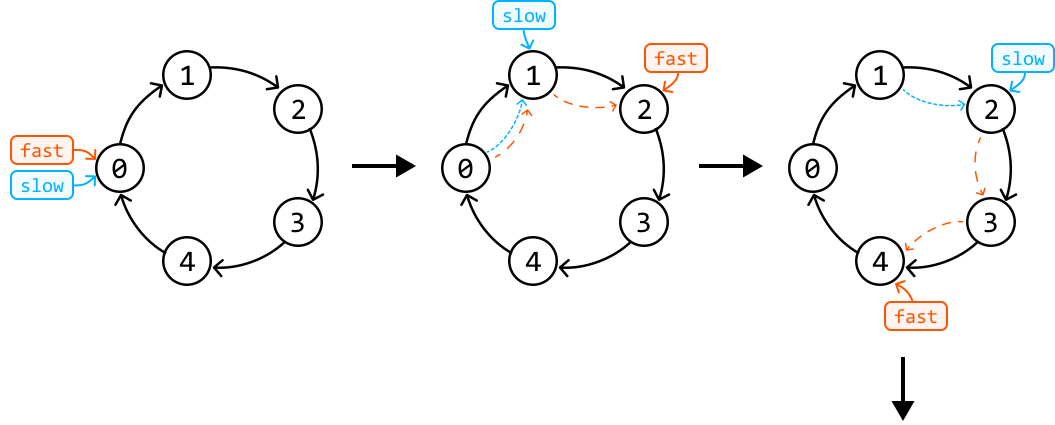
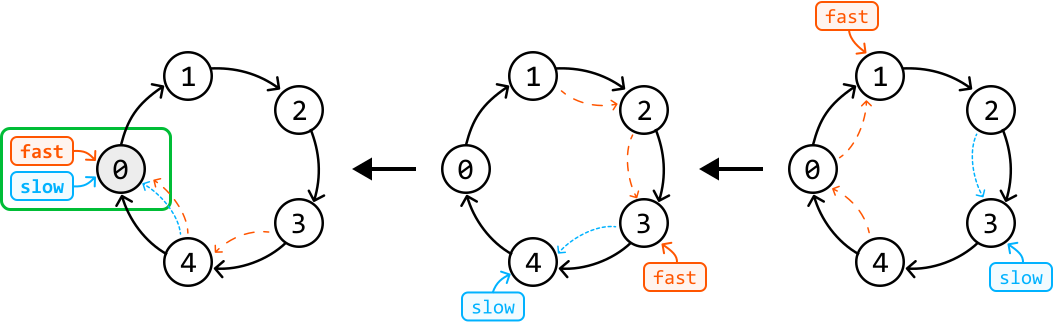
First, let’s check whether the two runners, represented as a slow pointer and a fast pointer, will reunite in a linked list that forms a perfect cycle. As we can see from the figure below, the pointers will eventually meet.
Delayed cycle
What about when the cycle doesn’t start immediately in the linked list? Consider simulating the fast and slow pointer technique over the following example:
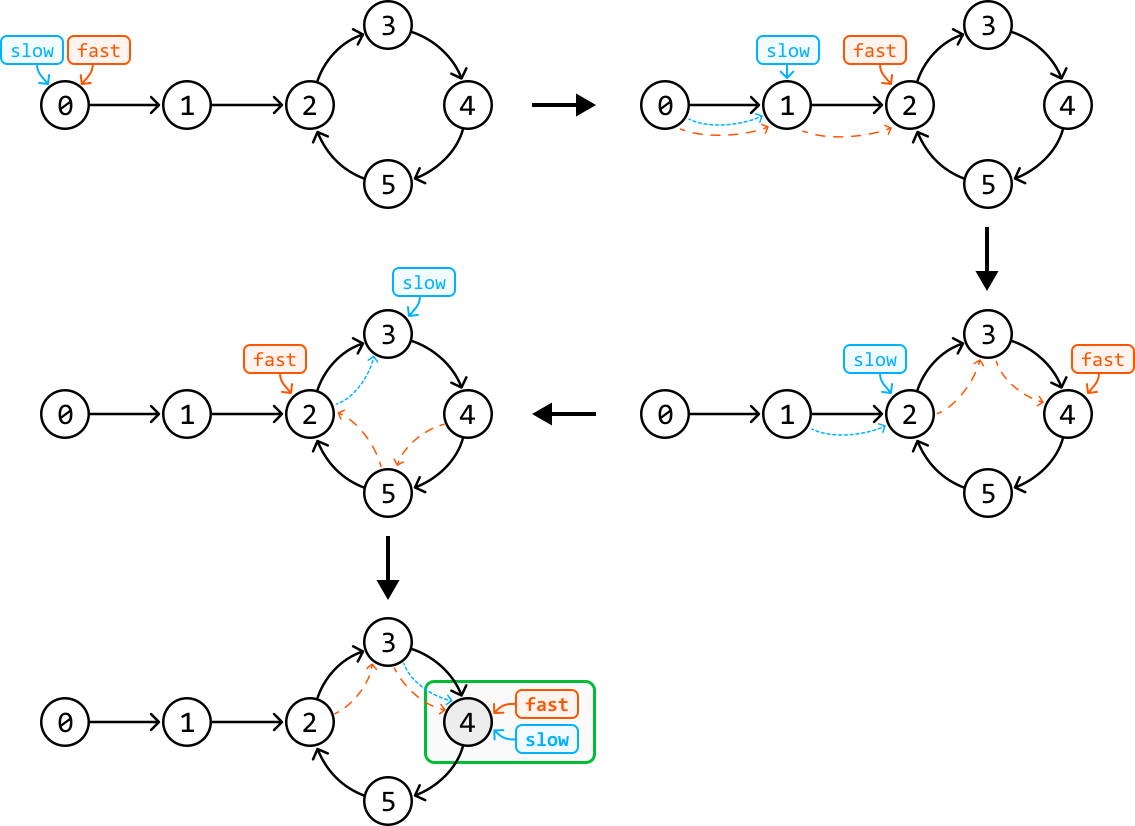
Again, the pointers eventually met in the cycle despite the fact that fast and slow entered the cycle at different times.
Will fast always catch up with slow?
In both cases, it might seem like the fast pointer could keep overtaking the slow pointer without ever meeting it, but this isn’t true. Here’s an easier way to understand why they will meet.
The fast pointer moves 2 steps at a time, and the slow pointer moves 1 step at a time, so the fast pointer will gain a distance of 1 node over the slow pointer at each iteration. This can be observed below, where the distance between the fast and slow pointers reduces by one in each iteration until they inevitably meet.
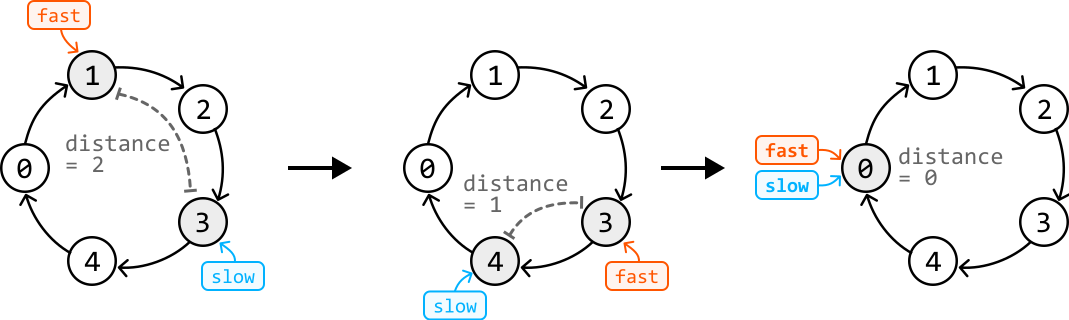
Therefore, the maximal number of steps required for the fast pointer to catch up with the slower pointer is k steps (once both are in the cycle), where k is the length of the cycle. In the worst case, the cycle will contain all the linked list’s nodes, and the pointers will eventually meet in n steps.
No cycle
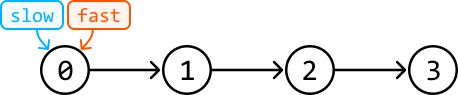
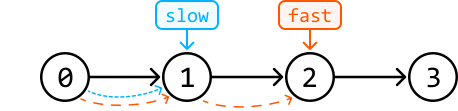
The final case is when there is no cycle. In this case, the fast pointer will eventually reach the end of the list and exit the while-loop:

This algorithm is formally known as ‘Floyd's Cycle Detection’ algorithm [1].
from ds import ListNode

def linked_list_loop(head: ListNode) -> bool:
    slow = fast = head
    # Check both 'fast' and 'fast.next' to avoid null pointer exceptions when we
    # perform 'fast.next' and 'fast.next.next'.
    while fast and fast.next:
        slow = slow.next
        fast = fast.next.next
        if fast == slow:
            return True
    return False
bool linkedListLoop(ListNode* head) {
ListNode* slow = head;
ListNode* fast = head;
while (fast != nullptr && fast->next != nullptr) {
slow = slow->next; // one step
fast = fast->next->next; // two steps
if (slow == fast) { // hare caught the tortoise
return true;
}
}
return false; // fast fell off the end -> no cycle
}public boolean linkedListLoop(ListNode head) {
ListNode slow = head;
ListNode fast = head;
while (fast != null && fast.next != null) {
slow = slow.next; // one step
fast = fast.next.next; // two steps
if (slow == fast) { // hare caught the tortoise
return true;
}
}
return false; // fast fell off the end -> no cycle
}Time complexity: The time complexity of linked_list_loop is because the fast pointer will meet the slow pointer in a linear number of steps, as described.
Space complexity: The space complexity is .
Two step-by-step walkthroughs of the algorithm below: a valid case (the expected happy path) and an invalid / edge case that exercises the tricky parts. Each step shows the program state as the code runs—the same steps apply to Python, C++ and Java.
slow (+1) fast (+2)
| iteration | slow | fast | slow == fast? |
|---|---|---|---|
| start | 3 | 3 | (pre-loop) |
| 1 | 2 | 0 | no |
| 2 | 0 | 2 | no |
| 3 | -4 | -4 | yes → return true |
slow (+1) fast (+2)
fast != null is now false, so the loop stops with no collision → return false. No cycle. ✅
| iteration | slow | fast | slow == fast? |
|---|---|---|---|
| start | 1 | 1 | (pre-loop) |
| 1 | 2 | 3 | no |
| 2 | 3 | null | no |
| guard fails | 3 | null | no collision → return false |
Contrast with Dry run 1: with a cycle the hare keeps looping and eventually laps the tortoise, so they collide. Without a cycle the hare simply runs off the end — fast (or fast.next) becomes null, the loop guard fails, and we return false. That guard is exactly what makes the two-step safe.
Both runs step exactly as the tables above. Python guards with while fast is not None and fast.next is not None, and the collision test is slow is fast (identity).
Same steps. C++ guards with while (fast && fast->next); the test is slow == fast on the pointers.
Same steps. Java guards with while (fast != null && fast.next != null); the test is slow == fast on the references.