New to this one? Start here. Below is the core idea in everyday language, plus a real-world analogy—then the sections that follow build on it with the formal reasoning, code, and step-by-step walkthroughs.
⭐ Real-world analogy: stars that line up in the sky
Look up at the night sky and some stars appear to fall on one straight line from where you stand. Fix your eye on one star (the focal point) and measure the direction (slope) to every other star; those sharing the same slope line up with it. The biggest such group is the most collinear points.
One Big Idea
Fix one focal point and compute the slope from it to every other point. Points sharing the same slope are collinear through the focal point. Count slopes with a hash map, take the biggest group (+1 for the focal point), and repeat for every focal point.
Intuition
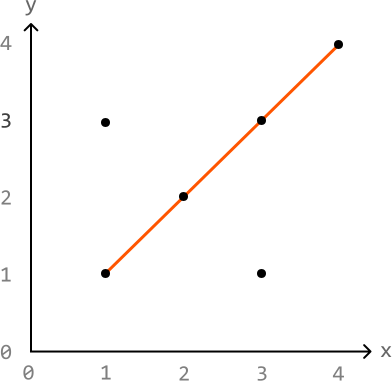
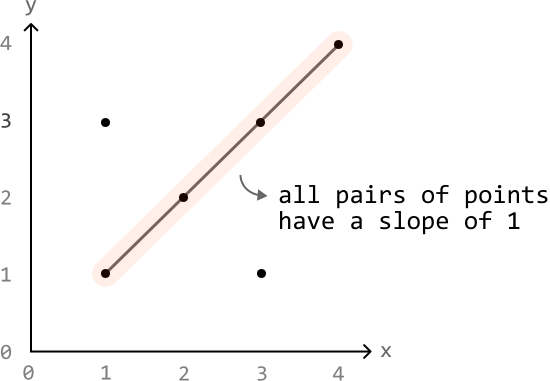
Two or more points are collinear if they lie on the same straight line. In other words, the slope between any pair of points among them will be equal:
Let’s remind ourselves how the slope of a line is calculated given two points (xa, ya) and (xb, yb):
slope=rise/run=(yb−ya)/(xb−xa)
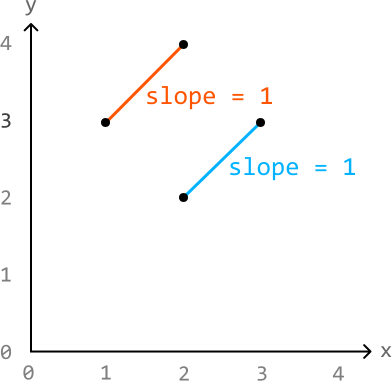
Using this formula, we can calculate the slope between all pairs of points from the input, and determine the largest number of pairs that share the same slope. However, this approach is flawed because two pairs of points with the same slope value may not be collinear:
Let's think of a different way to find the answer. What if we try to find the maximum number of points collinear with a specific point? Let’s call this point a focal point.
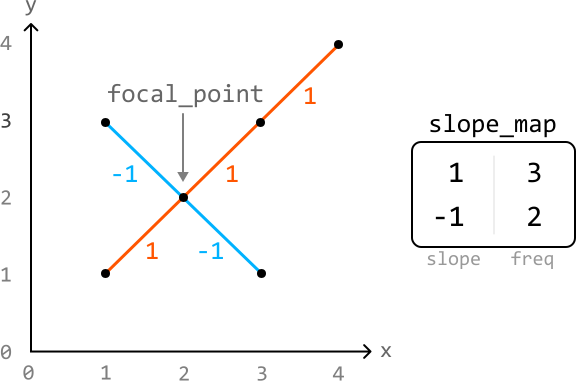
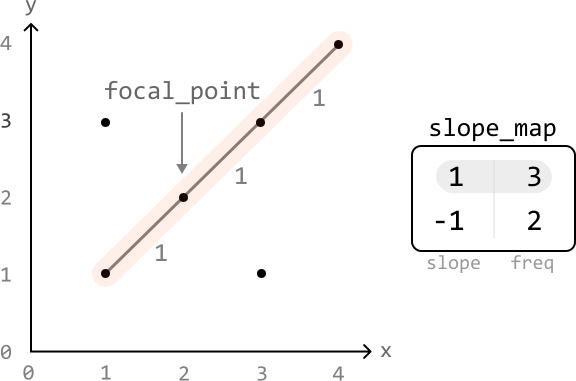
We can calculate the slope between the focal point and every other point in the input, using a hash map to count how many points correspond with each slope value. Note that the frequencies of points stored in the hash map do not include the focal point.
This allows us to find the maximum number of points collinear with this focal point:
Here, the slope with the highest frequency is 3, which means the number of points on the line defined by that slope is 3 + 1 = 4, where +1 is used to account for the focal point itself.
By repeating the process for every point, we can determine the maximum number of points that are collinear with each focal point. Our final answer is equal to the largest of these maximums.
Edge case: two points on the same x-axis
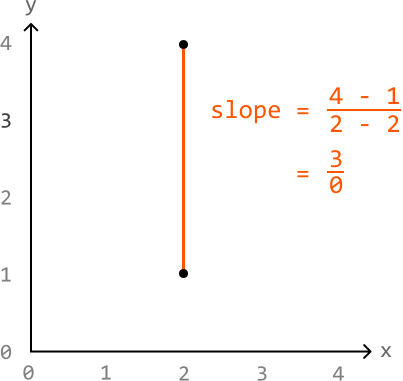
When two collinear points share the same x-axis, the denominator of the slope equation will equal 0 (i.e., run=xb−xa=0). This is problematic because dividing by 0 is undefined:
To handle this issue, we can check if our run value is equal to 0. If so, we can just use infinity (float('inf')) to represent the value of this slope.
Avoiding precision issues
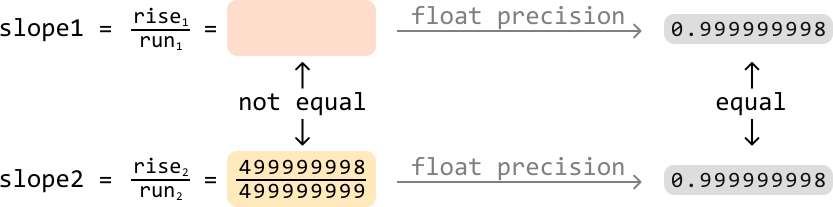
A crucial thing to be mindful of is the precision of slopes when storing them as floats or doubles. Consider the following slopes:
As we can see, despite the fractions themselves representing different slopes, presenting them as a float or double doesn’t provide enough decimal-point precision to distinguish between them accurately. This can result in incorrectly identifying distinct slopes as the same.
To avoid this, we can represent a slope as a pair of integers, stored as a tuple: (rise, run). For example, the slope with a rise of 1 and a run of 2 can be represented as (1, 2) instead of 1 / 2 = 0.5.
Ensuring consistent representation of slopes
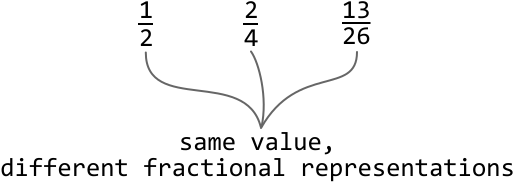
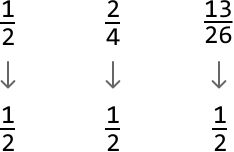
There’s just one more challenge to address: ensuring the representation of a slope is consistent for all equivalent slope fractions:
If we reduce fractions to their simplest forms, we can consistently represent equal fractions that have different initial representations.
But how can we do this? We can reduce fractions by dividing both the rise and run by their greatest common divisor (GCD).
Greatest common divisor
The GCD of two numbers is the largest number that divides both of them exactly. By dividing the rise and run by their GCD, we reduce the slope to its simplest form:
This ensures all equal fractions are represented in the same way.
Implementation
from typing import List, Tuple
from collections import defaultdict

def maximum_collinear_points(points: List[List[int]]) -> int:
    res = 0
    # Treat each point as a focal point, and determine the maximum number of points
    # that are collinear with each focal point. The largest of these maximums is the
    # answer.
    for i in range(len(points)):
        res = max(res, max_points_from_focal_point(i, points))
    return res

def max_points_from_focal_point(focal_point_index: int, points: List[List[int]]) -> int:
    slopes_map = defaultdict(int)
    max_points = 0
    # For the current focal point, calculate the slope between it and every other
    # point. This allows us to group points that share the same slope.
    for j in range(len(points)):
        if j != focal_point_index:
            curr_slope = get_slope(points[focal_point_index], points[j])
            slopes_map[curr_slope] += 1
            # Update the maximum count of collinear points for the current focal
            # point.
            max_points = max(max_points, slopes_map[curr_slope])
    # Add 1 to the maximum count to include the focal point itself.
    return max_points + 1

def get_slope(p1: List[int], p2: List[int]) -> Tuple[int, int]:
    rise = p2[1] - p1[1]
    run = p2[0] - p1[0]
    # Handle vertical lines separately to avoid dividing by 0.
    if run == 0:
        return (1, 0)
    # Simplify the slope to its reduced form.
    gcd_val = gcd(rise, run)
    return (rise // gcd_val, run // gcd_val)
int gcdInt(int a, int b) {
    a = abs(a); b = abs(b);
    while (b != 0) { int t = a % b; a = b; b = t; }
    return a;
}

pair<int, int> getSlope(const vector<int>& p1, const vector<int>& p2) {
    int rise = p2[1] - p1[1];
    int run = p2[0] - p1[0];
    if (run == 0) {
        return {1, 0};              // vertical line
    }
    int g = gcdInt(rise, run);
    rise /= g;
    run /= g;
    if (run < 0) {                  // canonical sign: run > 0
        rise = -rise;
        run = -run;
    }
    return {rise, run};
}

int maxPointsFromFocal(int focal, const vector<vector<int>>& points) {
    map<pair<int, int>, int> slopes;
    int best = 0;
    for (int j = 0; j < (int)points.size(); j++) {
        if (j != focal) {
            pair<int, int> s = getSlope(points[focal], points[j]);
            slopes[s]++;
            if (slopes[s] > best) best = slopes[s];
        }
    }
    return best + 1;               // include the focal point itself
}

int maximumCollinearPoints(vector<vector<int>> points) {
    int res = 0;
    for (int i = 0; i < (int)points.size(); i++) {
        res = max(res, maxPointsFromFocal(i, points));
    }
    return res;
}
int maximumCollinearPoints(int[][] points) {
    int res = 0;
    for (int i = 0; i < points.length; i++) {
        res = Math.max(res, maxPointsFromFocal(i, points));
    }
    return res;
}

int maxPointsFromFocal(int focal, int[][] points) {
    java.util.HashMap<String, Integer> slopes = new java.util.HashMap<>();
    int best = 0;
    for (int j = 0; j < points.length; j++) {
        if (j != focal) {
            String s = getSlope(points[focal], points[j]);
            int c = slopes.getOrDefault(s, 0) + 1;
            slopes.put(s, c);
            best = Math.max(best, c);
        }
    }
    return best + 1;               // include the focal point itself
}

String getSlope(int[] p1, int[] p2) {
    int rise = p2[1] - p1[1];
    int run = p2[0] - p1[0];
    if (run == 0) {
        return "1,0";              // vertical line
    }
    int g = gcdInt(rise, run);
    rise /= g;
    run /= g;
    if (run < 0) {                  // canonical sign: run > 0
        rise = -rise;
        run = -run;
    }
    return rise + "," + run;
}

int gcdInt(int a, int b) {
    a = Math.abs(a); b = Math.abs(b);
    while (b != 0) { int t = a % b; a = b; b = t; }
    return a;
}
While some programming languages, Python included, have their own internal implementation of the GCD function, its implementation is provided below for your information. This implementation is commonly known as the Euclidean algorithm:
# The Euclidean algorithm.
def gcd(a, b):
    while b != 0:
        a, b = b, a % b
    return a
Complexity Analysis
Time complexity: The time complexity of maximum_collinear_points is O(n2log(m)), where n denotes the number of points, and m denotes the largest value among the coordinates. Here’s why:
The time complexity of the gcd(rise, run) function is O(log(min(rise,run))), which is approximately equal to O(log(m)) in the worst case.
The helper function max_points_from_focal_point, calls the gcd function a total of n-1 times: one for each point excluding the focal point, giving a time complexity of O(nlog(m)).
The max_points_from_focal_point function is called a total of n times, resulting in an overall time complexity of O(n2log(m)).
Space complexity: The space complexity is O(n) due to the hash map, which in the worst case, stores n−1 key-value pairs: one for each point excluding the focal point.
Dry Runs
Two step-by-step walkthroughs of the algorithm below: a valid case (the expected happy path) and an invalid / edge case that exercises the tricky parts. Each step shows the program state as the code runs—the same steps apply to Python, C++ and Java.
✅ Dry run 1 (valid) — focal point (1,1) from the example.
Slopes from (1,1) to every other point, reduced.
other point
rise, run
reduced slope
(1,3)
2, 0
(1, 0) vertical
(2,2)
1, 1
(1, 1)
(3,1)
0, 2
(0, 1)
(3,3)
2, 2
(1, 1)
(4,4)
3, 3
(1, 1)
Slope (1, 1) appears 3 times → 3 + 1 focal = 4. ✓
❌ Dry run 2 (edge) — fewer than 3 points, and a vertical line.
With 0, 1, or 2 points the answer is just the count (any 2 points are trivially collinear). Vertical lines would divide by zero if we used raw slope — the run == 0 → (1, 0) special case groups them correctly, e.g. (1,1) and (1,3) share slope (1, 0).